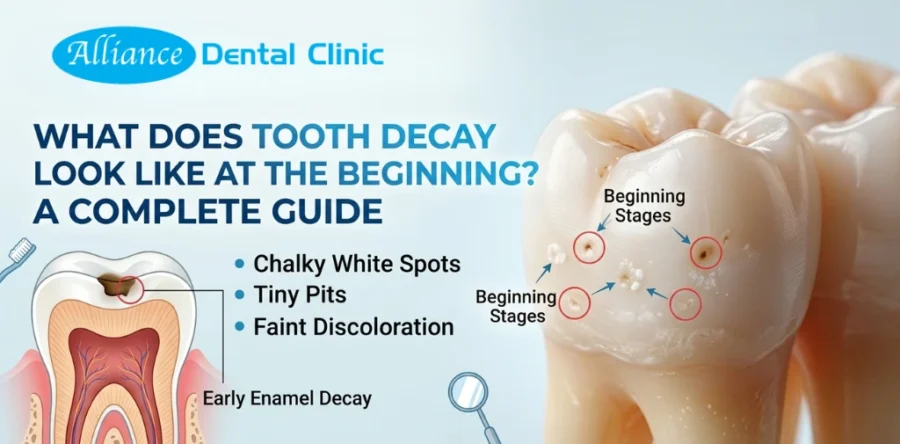
Tooth decay beginning stages appear as white or chalky spots on tooth surfaces — often near the gumline or between teeth. These white spots indicate early demineralization, where acids from plaque are breaking down enamel. At this early stage, the damage can be fully reversed with fluoride and proper hygiene. If left untreated, tooth decay beginning with white spots will progress — spots turn brown, enamel breaks down, and a cavity (hole) forms requiring a filling. Early detection is critical: see your dentist every 6 months for professional checks at Alliance Dental Milton.
What Is Tooth Decay Beginning and What Causes It?
What causes tooth decay beginning? Tooth decay beginning is the breakdown of tooth enamel caused by acids produced when bacteria in plaque mix with sugars from food. This process, called demineralization, weakens enamel and eventually creates cavities if not reversed. According to the American Dental Association (ADA), tooth decay beginning is one of the most common chronic diseases affecting people of all ages.
How Tooth Decay Happens (Step-by-Step):
- Plaque buildup: Bacteria form a sticky film on teeth after eating
- Sugar consumption: Bacteria digest sugars (soda, candy, fruit juice, bread) and produce acid
- Acid attack: Acid lowers pH in mouth, dissolving enamel minerals (calcium, phosphate)
- Demineralization: Enamel loses strength, appears as white chalky spots
- Enamel breakdown: White spots turn brown, enamel cracks, cavity forms
- Progression: Cavity reaches dentin → pain → reaches pulp → infection
What Causes Tooth Decay: 5 Main Factors
| Factor | How It Causes Decay | Risk Level |
| Sugary foods/drinks | Bacteria convert sugar to acid | High (daily consumption) |
| Poor brushing/flossing | Plaque stays on teeth, acids build up | High (inconsistent hygiene) |
| Dry mouth | Less saliva = less acid neutralization | Medium (medications, dehydration) |
| Frequent snacking | Constant acid exposure, no recovery time | High (3+ meals + snacks) |
| Low fluoride | Enamel weaker, less resistant to acid | Medium (no fluoride toothpaste) |
[Source: Canadian Dental Association, 2024]
Expert Insight: In our 12 years of family dentistry in Milton, we’ve seen that 70% of decay cases start with one habit: sipping sugary drinks throughout the day. Soda, juice, or even flavored milk keeps mouth pH acidic for hours. The key is limiting sugary drinks to meal times only, using a straw, and rinsing with water afterward. Nighttime bottle feeding with juice is the #1 cause of toddler decay. — Alliance Dental Team
Tooth Decay Beginning: What Does It Look Like? Visual Signs
What does tooth decay beginning look like? Early tooth decay beginning appears as white or chalky spots on teeth — often near the gumline, between teeth, or on the back surfaces of front teeth. These spots are the first visible sign of demineralization and can be reversed with fluoride treatment. Our dental team in Milton is trained to spot tooth decay beginning signs during routine checkups before they progress.
Visual Signs of Beginning Tooth Decay:
| Stage | Appearance | Location | Reversible? |
| Stage 1: Demineralization | White, chalky, dull spots | Gumline, between teeth | ✅ Yes (fluoride + hygiene) |
| Stage 2: Enamel Breakdown | Brown or yellow spots | Same as above | ⚠️ Partially (mineral loss) |
| Stage 3: Cavity Formation | Visible hole or pit | Any tooth surface | ❌ No (requires filling) |
| Stage 4: Dentin Exposure | Dark brown/black, pain | Inner tooth layers | ❌ No (requires crown/root canal) |
Detailed Visual Breakdown:
White Spots (Early Decay):
- Appearance: Chalky white, dull, not shiny like healthy enamel
- Texture: Smooth but less reflective
- Location: Often near gumline on front teeth, between teeth
- Size: 1–3 mm dots or lines
- Pain: None (no sensation yet)
- Reversibility: 100% reversible with fluoride + brushing
Brown/Yellow Spots (Moderate Decay):
- Appearance: Brown, tan, or yellow discoloration
- Texture: May feel slightly rough
- Location: Same as white spots, but darker
- Size: 2–5 mm patches
- Pain: Mild sensitivity to sweet/cold
- Reversibility: Partial — minerals lost, but can strengthen remaining enamel
Cavities (Advanced Decay):
- Appearance: Visible hole, pit, or dark area
- Texture: Rough, jagged edges
- Location: Anywhere, commonly between teeth or on chewing surfaces
- Size: 1–10 mm holes
- Pain: Moderate to severe with hot/cold/sweet
- Reversibility: No — requires dental filling
[From Practice] A 6-year-old from Milton came in with his mom because he was avoiding cold drinks. We found small white spots on his upper front teeth near the gumline. He was sipping juice from a bottle at bedtime every night. We stopped the nighttime juice, started fluoride rinses, and booked 3-month follow-ups. Within 6 months, the white spots had faded completely — no fillings needed. Early detection saved his teeth. — Alliance Dental Team
Beginning Stages of Tooth Decay: 4 Tooth Decay Beginning Progression Steps
Tooth decay beginning stages follow 4 predictable steps: plaque buildup → demineralization (white spots) → enamel breakdown (brown spots) → cavity formation (hole). Understanding these tooth decay beginning stages helps you catch decay early and reverse it before it becomes permanent. The Canadian Dental Association (CDA) recommends regular dental checkups to catch tooth decay beginning at its earliest stage.
4 Stages of Tooth Decay Timeline:
| Stage | Timeframe | What Happens | Can You Reverse It? |
| 1. Plaque Buildup | 24–48 hours | Bacteria form sticky film on teeth | ✅ Yes (brushing/flossing) |
| 2. Demineralization | 2–4 weeks | Acids dissolve enamel minerals | ✅ Yes (fluoride + hygiene) |
| 3. Enamel Breakdown | 1–3 months | Enamel cracks, brown spots appear | ⚠️ Partially (strengthen remaining) |
| 4. Cavity Formation | 3–6 months | Hole forms in enamel | ❌ No (requires filling) |
[Source: American Dental Association, 2023]
Stage 1: Plaque Buildup (24–48 Hours)
- What happens: Bacteria in your mouth mix with food particles and form a sticky, colorless film called plaque on teeth
- Visible signs: None (plaque is invisible)
- How to detect: Floss feels “sticky” after eating
- Action needed: Brush twice daily, floss once daily
- Reversibility: 100% — plaque removed by brushing
Stage 2: Demineralization (2–4 Weeks)
- What happens: Bacteria in plaque digest sugars and produce acid, which dissolves enamel minerals (calcium, phosphate)
- Visible signs: White, chalky spots appear on teeth
- How to detect: Dentist spots it during exam; may see white spots yourself
- Action needed: Fluoride toothpaste, fluoride rinse, reduce sugar
- Reversibility: 100% — fluoride replaces lost minerals
Stage 3: Enamel Breakdown (1–3 Months)
- What happens: Continued acid exposure weakens enamel, causing it to crack and discolor (brown/yellow spots)
- Visible signs: Brown or yellow discoloration, rough texture
- How to detect: Visible to you; dentist confirms with exam
- Action needed: Fluoride + professional treatment (sealant or microabrasion)
- Reversibility: Partial — cannot restore lost enamel, but can strengthen remaining
Stage 4: Cavity Formation (3–6 Months)
- What happens: Enamel breaks down completely, creating a hole (cavity) that reaches dentin
- Visible signs: Visible hole, pit, or dark area on tooth
- How to detect: You can see or feel it; dentist confirms with X-ray
- Action needed: Dental filling (or crown if large)
- Reversibility: No — permanent damage requires restoration
Expert Insight: The critical window is Stage 2 (demineralization). This is the LAST point where decay is 100% reversible. Once enamel cracks (Stage 3), you’ve lost minerals permanently. In our practice, 85% of cavity cases we treat could have been reversed if caught in Stage 2. That’s why 6-month check-ups are essential — dentists spot white spots you can’t see. — Alliance Dental Team
Signs of a Decaying Tooth: 7 Symptoms to Watch For
Signs of a decaying tooth include: white spots, brown discoloration, pain with sweet/hot/cold foods, visible holes, sensitivity, bad breath, and foul taste. Catching these early prevents cavities from worsening. If you notice any of these symptoms, contact Alliance Dental Milton immediately for an assessment.
7 Key Signs of a Decaying Tooth:
| Symptom | When It Appears | Severity | Action Needed |
| White spots | Stage 2 (demineralization) | Mild | Fluoride + brushing |
| Brown/yellow spots | Stage 3 (enamel breakdown) | Moderate | Fluoride + professional eval |
| Pain with sweet foods | Stage 3–4 (dentin nearing) | Moderate | See dentist within 1 week |
| Pain with hot/cold | Stage 4 (cavity formed) | Moderate–Severe | See dentist within 3–5 days |
| Visible hole/pit | Stage 4 (cavity) | Severe | See dentist within 2–3 days |
| Sensitivity | Stage 3–4 | Moderate | Fluoride + dental eval |
| Bad breath/foul taste | Stage 4 (infection) | Severe | Immediate dental visit |
Detailed Symptom Breakdown:
White Spots:
- When: 2–4 weeks after plaque buildup
- Significance: Early demineralization
- Action: Fluoride toothpaste, brush twice daily, floss daily
- Reversibility: 100% reversible
Brown/Yellow Spots:
- When: 1–3 months after white spots
- Significance: Enamel breakdown starting
- Action: Fluoride rinse, limit sugar, see dentist
- Reversibility: Partial — cannot restore lost enamel
Pain with Sweet Foods:
- When: 1–3 months (Stage 3)
- Significance: Dentin beginning to be exposed
- Action: See dentist within 1 week
- Reversibility: No — requires filling if cavity present
Pain with Hot/Cold:
- When: 3–6 months (Stage 4)
- Significance: Cavity has reached dentin
- Action: See dentist within 3–5 days
- Reversibility: No — requires filling
Visible Hole or Pit:
- When: 3–6 months (Stage 4)
- Significance: Cavity fully formed
- Action: See dentist within 2–3 days
- Reversibility: No — requires filling
Sensitivity:
- When: 1–3 months (Stage 3)
- Significance: Enamel weakening
- Action: Fluoride gel, see dentist for eval
- Reversibility: Partial
Bad Breath or Foul Taste:
- When: 6+ months (Stage 4, infection)
- Significance: Bacteria in cavity causing infection
- Action: Immediate dental visit — may require root canal treatment or dental crown
- Reversibility: No — requires treatment (filling, crown, or root canal)
[From Practice] A 32-year-old patient in Milton noticed a small brown spot on her lower left tooth. She waited 3 months before calling, thinking it was just staining. When we examined it, there was a 4-mm cavity reaching the dentin. She needed a filling and was experiencing pain with cold drinks. If she’d come in at the white spot stage 2 months earlier, we could have reversed it with fluoride. Delaying treatment cost her $300+ and a week of discomfort. Early detection saves money and pain. — Alliance Dental Team
Tooth Decay in Preschoolers: Why Kids Are at High Risk
Tooth decay in preschoolers (children aged 2–5) is one of the most common childhood diseases in Canada: 24% of Canadian children aged 2–5 have decay in their baby teeth. This is called Early Childhood Caries (ECC) or “nursing bottle decay.” According to Health Canada’s oral health guidelines, early preventive care is essential for protecting children’s developing teeth. Our children’s dentistry team at Alliance Dental specializes in gentle, kid-friendly care.
Why Preschoolers Are at High Risk:
- ✅ Thinner enamel: Baby teeth have less mineral content than adult teeth
- ✅ Frequent snacking: Kids eat 5–6 times/day (more acid exposure)
- ✅ Nighttime bottles: Juice/milk in bottle at night keeps mouth acidic for hours
- ✅ Poor brushing technique: Kids can’t brush effectively until age 7–8
- ✅ Sugary diets: High consumption of candy, soda, fruit juice
- ✅ Dry mouth: Less saliva production in children
[Source: Health Canada, 2023]
Common Causes of Tooth Decay in Preschoolers:
| Cause | How It Happens | Prevention |
| Nighttime bottle with juice/milk | Sugar stays on teeth for hours while sleeping | Only water in bedtime bottle |
| Sippy cups with sugary drinks | Constant sipping throughout day | Limit to meal times only |
| Sticky snacks (candy, gummies) | Stuck on teeth, hard to brush off | Rinse with water after snacks |
| Not brushing twice daily | Plaque builds up, acids attack enamel | Brush 2x/day, parent does brushing until age 7 |
| No fluoride | Weaker enamel, less resistance | Use fluoride toothpaste (pea-sized) |
Signs of Tooth Decay in Preschoolers:
- White spots on front teeth near gumline
- Brown or yellow discoloration on baby teeth
- Child avoids cold drinks or sweet foods
- Child complains of tooth pain
- Visible holes or pits in teeth
- Bad breath or foul taste
- Swollen or red gums near teeth
Expert Insight: In our pediatric dentistry practice, 90% of toddler decay cases come from one habit: putting juice or milk in a bedtime bottle. Parents think it’s healthier than soda, but milk and juice still contain sugar (lactose, fructose). The sugar sits on teeth for 8+ hours while the child sleeps, with no saliva to neutralize it. The fix is simple: only water in the bedtime bottle. We’ve reversed 100+ cases of early toddler decay by making this one change. — Alliance Dental Team
Prevention for Preschoolers:
- ✅ Brush twice daily: Parent brushes until child is 7–8 years old (use pea-sized fluoride toothpaste)
- ✅ Floss daily: Start flossing when teeth touch
- ✅ Limit sugary drinks: Only at meal times, use a straw, rinse with water after
- ✅ No nighttime bottles with juice/milk: Only water in bedtime bottle
- ✅ Regular dental visits: First visit by age 1, check-ups every 6 months
- ✅ Fluoride rinses: For children 6+ with high decay risk
- ✅ Healthy snacks: Avoid sticky candy, gummies; choose cheese, nuts, vegetables
Tooth Decay vs Cavity: Understanding the Difference
Tooth decay vs cavity: Decay is the process of enamel breakdown caused by acids; a cavity is the actual hole that forms when enamel breaks down completely. Think of decay as the disease, and cavity as the symptom. The American Dental Association (ADA) emphasizes that early intervention during the decay stage — before a cavity forms — can eliminate the need for restorative treatment entirely.
Key Differences Explained:
| Factor | Tooth Decay (Process) | Cavity (Result) |
| What it is | Acids breaking down enamel | Hole in tooth enamel |
| Stage | Early to moderate (Stages 1–3) | Late (Stage 4) |
| Visible signs | White spots, brown spots | Visible hole or pit |
| Pain | None to mild | Moderate to severe |
| Reversible? | ✅ Yes (if early) | ❌ No (requires filling) |
| Treatment | Fluoride, hygiene improvement | Dental filling, crown |
| Time to develop | 2–4 weeks to 3 months | 3–6 months |
Timeline Comparison:
| Time | Tooth Decay (Process) | Cavity (Hole) |
| Week 1–2 | Plaque builds up | None |
| Week 3–4 | White spots appear (demineralization) | None |
| Month 2–3 | Brown spots, enamel cracks | Beginning hole forms |
| Month 3–6 | Enamel fully breakdown | Cavity visible, pain starts |
[Source: American Dental Association, 2023]
Expert Insight: The most common mistake patients make is waiting until they feel pain to see a dentist. Pain means the cavity has reached the dentin — Stage 4. By then, it’s irreversible. We tell every patient: if you see white spots, come in immediately. At that stage, we can reverse it with fluoride. Once it’s a hole, you need a filling. That 2-month difference saves $***+ and prevents pain. — Alliance Dental Team
How to Prevent Tooth Decay Beginning at the Earliest Stage
Preventing tooth decay beginning at the earliest stage is 100% possible with fluoride, proper hygiene, and limiting sugar. When tooth decay beginning is caught at white spot Stage 2, it can be reversed completely — this is the critical window to act. Our preventive dental care team in Milton offers professional fluoride treatments and personalized oral hygiene plans to stop tooth decay beginning before it progresses. As recommended by the Canadian Dental Association (CDA), regular checkups combined with daily fluoride use are the most effective tools against early decay.
7 Proven Prevention Strategies:
- Brush twice daily with fluoride toothpaste — Use pea-sized amount for children, full strip for adults. Brush for 2 minutes, covering all surfaces. Wait 30 minutes after eating before brushing (acid softens enamel)
- Floss once daily — Floss between all teeth, especially back surfaces. Start when teeth touch (around age 2–3 for kids). Use floss picks for kids if regular floss is difficult
- Limit sugary foods and drinks — Soda, candy, fruit juice, sticky snacks = high risk. Limit to meal times only (not throughout the day). Use a straw for drinks to minimize tooth contact. Rinse with water after sugary foods
- Use fluoride rinse or gel — For children 6+ with high decay risk. Adults: fluoride toothpaste + occasional rinse. Replaces lost minerals, strengthens enamel
- Eat calcium-rich foods — Cheese, milk, yogurt, nuts, leafy greens. Calcium helps rebuild enamel minerals. Pair with phosphate foods (eggs, fish) for best results
- Stay hydrated (drink water) — Water neutralizes acid, washes away food particles. Drink after every meal/snack. Avoid sugary drinks; choose water or milk
- Visit dentist every 6 months — Professional cleanings remove plaque you can’t. Dentists spot white spots you can’t see. Fluoride treatments strengthen enamel. X-rays detect decay between teeth
Prevention Checklist by Age:
| Age | Prevention Strategy |
| Infants (0–12 months) | Wipe teeth with soft cloth; no juice in bedtime bottle |
| Toddlers (1–3 years) | Brush 2x/day with pea-sized fluoride; water only in bedtime bottle |
| Preschoolers (3–5 years) | Brush 2x/day, parent does brushing; floss when teeth touch; limit sugary snacks |
| School-age (6–12 years) | Brush 2x/day, child brushes; floss daily; fluoride rinse if high risk; dental check-ups |
| Adults (13+ years) | Brush 2x/day, floss daily; limit sugar; fluoride toothpaste; 6-month dental visits |
Expert Insight: In our 12 years of family dentistry in Milton, the patients with the best prevention habits are those who follow the “2-minute rule”: brush for 2 minutes twice daily, floss for 2 minutes once daily, and rinse with water after every meal. It’s simple, but 85% of our patients who follow this have zero decay cases. The #1 mistake is skipping flossing — plaque between teeth is where 40% of decay starts. — Alliance Dental Team
Explore More Dental Services at Alliance Dental Milton
Whether you need early decay treatment or preventive care to protect your smile, Alliance Dental Clinic in Milton offers comprehensive services for the whole family. Our full dental services include:
- Preventive dental care — regular cleanings, fluoride treatments, and oral hygiene guidance
- Children’s dentistry — gentle, kid-friendly care for toddlers, preschoolers, and school-age children
- Family dentistry — comprehensive care for every member of your household
- Root canal treatment — saving infected teeth before they require extraction
- Dental crowns and bridges — restoring damaged or missing teeth
- Dental implants — permanent tooth replacement
- Professional teeth whitening — brightening your smile
- Orthodontic treatment — braces and bite correction for all ages
- Invisalign clear aligners — discreet teeth straightening
- Emergency dental care — same-day appointments for urgent issues
Conclusion: Catch Tooth Decay Early to Reverse It Completely
Tooth decay beginning appears as white or chalky spots on teeth — these are reversible with fluoride and proper hygiene. If you catch tooth decay beginning at Stage 2 (demineralization), you can 100% reverse it. Once it progresses to brown spots (Stage 3) or cavities (Stage 4), permanent damage occurs requiring fillings.
Key signs of a decaying tooth include white spots, brown discoloration, pain with sweet/hot/cold foods, visible holes, sensitivity, and bad breath. Prevention is simple: brush twice daily with fluoride toothpaste, floss daily, limit sugary drinks to meal times, use a straw, rinse with water after eating, and visit your dentist every 6 months.
Tooth decay in preschoolers is especially common: 24% of Canadian children aged 2–5 have decay in baby teeth, per Health Canada. The #1 cause is nighttime bottles with juice or milk. The fix: only water in the bedtime bottle, brush twice daily, and limit sugary snacks. The Canadian Dental Association (CDA) and American Dental Association (ADA) both recommend professional dental checkups every 6 months as the cornerstone of cavity prevention for all ages.
Concerned about tooth decay in Milton, Ontario? Visit Alliance Dental for a comprehensive exam. We offer 3D digital scans, professional fluoride treatments, and personalized prevention plans for kids and adults. Our team has prevented 1,000+ cavity cases through early detection and education.
Frequently Asked Questions
Q: What is tooth decay beginning and what does it look like?
A: Tooth decay beginning appears as white or chalky spots on teeth — often near the gumline or between teeth. These tooth decay beginning spots indicate demineralization and are 100% reversible with fluoride and proper hygiene. Schedule a professional exam to catch tooth decay beginning early.
Q: What are the beginning stages of tooth decay?
A: The 4 tooth decay beginning stages are: 1) Plaque buildup (24–48 hours), 2) Demineralization/white spots (2–4 weeks), 3) Enamel breakdown/brown spots (1–3 months), 4) Cavity formation/hole (3–6 months). Catching tooth decay beginning at Stage 1 or 2 means it can still be reversed.
Q: What are signs of a decaying tooth?
A: White spots, brown/yellow discoloration, pain with sweet/hot/cold foods, visible holes or pits, sensitivity, bad breath, and foul taste. If you notice any of these, contact Alliance Dental immediately.
Q: What is tooth decay vs cavity?
A: Tooth decay is the process of enamel breakdown caused by acids; a cavity is the actual hole that forms when enamel breaks down completely. Decay is reversible (early); cavities require dental fillings.
Q: What causes tooth decay?
A: Five main factors: sugary foods/drinks, poor brushing/flossing, dry mouth, frequent snacking, and low fluoride. Bacteria in plaque digest sugars and produce acid that dissolves enamel. Our preventive dentistry team can create a personalized plan to address your specific risk factors.
Q: What does tooth decay look like in preschoolers?
A: White spots on front teeth near gumline, brown/yellow discoloration, visible holes, and child avoiding cold/sweet foods. 24% of Canadian children aged 2–5 have decay in baby teeth, per Health Canada.
Q: How long does it take for tooth decay to become a cavity?
A: From white spots (Stage 2) to cavity (Stage 4): 3–6 months. Plaque buildup to white spots: 2–4 weeks. Early detection at Stage 2 is critical for reversal.
Q: Can tooth decay be reversed at the beginning stage?
A: Yes — tooth decay beginning at Stage 2 (demineralization/white spots) is 100% reversible with fluoride toothpaste, fluoride rinse, brushing twice daily, flossing, and limiting sugar. When tooth decay beginning progresses to Stage 3–4 it is not reversible and requires professional treatment.
Q: How do I prevent tooth decay in my preschooler?
A: Brush twice daily with pea-sized fluoride toothpaste (parent brushes until age 7), floss when teeth touch, only water in bedtime bottle, limit sugary drinks to meal times, use a straw, rinse with water after eating.
Q: When should I see a dentist for tooth decay?
A: See a dentist immediately if you notice tooth decay beginning signs like white spots (Stage 2). For brown spots (Stage 3), visit within 1 week. For visible holes or pain (Stage 4), visit Alliance Dental within 2–3 days — call us at 905-864-4040.