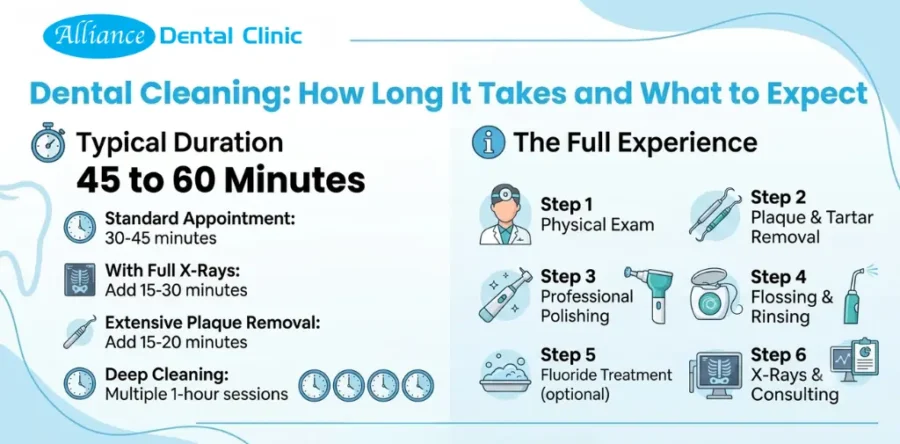
How long does a dental cleaning take? Most routine dental cleanings (prophylaxis) last 30–60 minutes, while deep cleanings (scaling and root planing) take 60–90 minutes per session. In addition, your appointment may be longer if x-rays, a comprehensive exam, or fluoride treatment are included. The exact duration depends on your gum health, plaque buildup level, and whether you’re having regular or deep cleaning. As a result, most patients schedule 60–90 minutes total for their visit to allow for all components. At Alliance Dental Milton, our hygienists customize every cleaning to your individual oral health needs.
What Is Dental Cleaning and Why It’s Important
What is dental cleaning? Dental cleaning (prophylaxis) is a professional teeth cleaning procedure where a dentist or hygienist removes plaque, tartar (calculus), and stains from tooth surfaces and along the gumline. Unlike brushing at home, professional cleaning reaches areas you can’t access and, furthermore, removes hardened tartar that brushing can’t eliminate. According to the American Dental Association (ADA), professional cleanings are a cornerstone of preventive oral health care for patients of all ages.
Why Dental Cleaning Is Essential:
- Prevents gum disease: Removes plaque that causes gingivitis and periodontitis
- Prevents cavities: Reduces bacteria that produce acid and erode enamel
- Improves breath: Removes bacteria that cause bad odor
- Brightens teeth: Removes surface stains from coffee, tea, wine
- Early detection: Dentist spots decay, gum disease, or oral cancer early
- Overall health: Links to reduced heart disease, diabetes complications [Source: American Dental Association, 2023]
Dental Cleaning vs. Brushing at Home:
| Factor | Professional Cleaning | Brushing at Home |
| Plaque removal | Removes all plaque + tartar | Removes soft plaque only |
| Tartar removal | Yes (special tools) | No (tartar is hardened) |
| Gumline access | Deep cleaning below gumline | Limited (surface only) |
| Stain removal | Polishing removes stains | Partial (surface only) |
| Time | 30–90 minutes | 2 minutes |
| Frequency | Every 6 months | Twice daily |
[From Practice] A 45-year-old patient from Milton came in every year thinking brushing twice daily was enough. However, when we checked her gums, they were red and bleeding — classic gingivitis. Her at-home brushing couldn’t remove the tartar below her gumline. As a result, after one professional cleaning, her gums stopped bleeding within 2 weeks. She said, “I never realized how much buildup was there until you cleaned it.” Consequently, regular cleanings changed her oral health completely. — Alliance Dental Team
Expert Insight: In our 12 years of family dentistry in Milton, we’ve cleaned 3,000+ teeth. The #1 mistake patients make is skipping cleanings because they “brush well at home.” Brushing removes soft plaque, but once plaque hardens into tartar (within 24–72 hours), it’s impossible to remove without professional tools. Therefore, even the best brushers need cleanings every 6 months. — Alliance Dental Team
How Long Is a Dental Cleaning? Time Breakdown by Type
How long is a dental cleaning? A standard dental cleaning takes 30–60 minutes for routine cases, but deep cleanings for gum disease take 60–90 minutes per session. Moreover, your total appointment time may be 60–90 minutes if x-rays and exam are included. The Canadian Dental Association (CDA) recommends scheduling sufficient appointment time to ensure a thorough and comfortable cleaning experience.
Dental Cleaning Duration by Type:
| Cleaning Type | Duration | Sessions Needed | Best For |
| Routine cleaning (prophylaxis) | 30–60 minutes | 1 | Healthy gums, regular maintenance |
| Deep cleaning (scaling/root planing) | 60–90 minutes | 2–4 sessions | Gum disease (gingivitis/periodontitis) |
| Tartar removal only | 45–75 minutes | 1 | Heavy buildup, missed cleanings |
| Pediatric cleaning | 20–40 minutes | 1 | Children (gentler, faster) |
| Senior cleaning | 40–60 minutes | 1 | Older adults (sensitive gums) |
[Source: Canadian Dental Association, 2024]
What Affects Cleaning Duration:
| Factor | Shorter Time | Longer Time |
| Gum health | Healthy gums (no bleeding) | Gum disease (bleeding, inflammation) |
| Plaque buildup | Light buildup (recent cleaning) | Heavy buildup (missed 1+ years) |
| Tartar amount | Minimal tartar | Heavy tartar below gumline |
| Number of teeth | Fewer teeth (partial cleaning) | Full mouth (all 28–32 teeth) |
| X-rays needed | No x-rays | Full mouth x-rays (add 15–20 min) |
| Exam included | Quick check-up | Comprehensive exam (add 15–20 min) |
| Fluoride treatment | No fluoride | Fluoride applied (add 10–15 min) |
| Sensitivity | No sensitivity | High sensitivity (slower pace) |
Timeline Breakdown: What Happens in Each Minute
0–10 minutes: Arrival & Prep
- Check-in at front desk
- Update health history
- X-rays (if needed): 10–15 minutes
- Hygienist reviews your oral health
10–20 minutes: Examination
- Dentist/hygienist checks gums for bleeding, inflammation
- Looks for cavities, worn teeth, oral cancer signs
- Discusses any concerns you have
20–50 minutes: Cleaning (30 min)
- Scraping/scaling: Remove plaque and tartar above and below gumline (15 min)
- Flossing: Clean between teeth (5 min)
- Polishing: Remove stains with gritty paste (10 min)
50–60 minutes: Finishing
- Rinse mouth
- Fluoride treatment (if included): 10–15 min
- Dentist final review
- Schedule next appointment
Expert Insight: Most patients ask, “Why does my cleaning take longer than my friend’s?” The answer is gum health. For instance, if your gums bleed during cleaning (gingivitis), the hygienist must work slower and more carefully to avoid pain. In contrast, healthy gums mean a faster cleaning. In our Milton dental clinic, cleanings range from 25 minutes (healthy gums, recent cleaning) to 75 minutes (gum disease, heavy buildup). Ultimately, the extra time is for your comfort and thoroughness. — Alliance Dental Team
Dental Cleaning Process: Step-by-Step What Happens
The dental cleaning process follows 5 standard steps: consultation, scaling (plaque/tartar removal), flossing, polishing, and fluoride treatment. Each step has a specific purpose and takes 5–15 minutes. Additionally, our dental services team at Alliance Dental Milton explains every step before proceeding to keep you informed and comfortable.
5-Step Dental Cleaning Process:
| Step | Duration | What Happens | Tools Used |
| 1. Consultation and X-Rays | 10–20 min | Review health history, check gums, take x-rays | X-ray machine, gum probe |
| 2. Scaling (Plaque/Tartar Removal) | 15–25 min | Remove plaque and tartar above and below gumline | Metal scaler, ultrasonic tool |
| 3. Flossing | 3–5 min | Clean between teeth, remove leftover debris | Dental floss, interdental brush |
| 4. Polishing | 5–10 min | Remove surface stains, smooth tooth surface | Gritty paste, rotating brush |
| 5. Fluoride Treatment | 10–15 min | Strengthen enamel, prevent cavities | Fluoride gel, tray, or rinse |
Step 1: Consultation and X-Rays (10–20 Minutes)
During Step 1, the hygienist reviews your medical and dental history, then checks for any changes since your last visit such as pain, bleeding, or sensitivity. Next, x-rays are taken if needed — full mouth x-rays take 15–20 minutes, while bite-wing x-rays take 5–10 minutes. Finally, the dentist examines your gums, teeth, and oral tissues for any concerns.
Why it’s important: First and foremost, x-rays detect decay between teeth, bone loss from gum disease, and problems hidden under gums. The American Dental Association (ADA) recommends routine x-rays as part of a comprehensive oral health assessment.
Step 2: Scaling – Plaque and Tartar Removal (15–25 Minutes)
During Step 2, the hygienist uses either a metal scaler (hand tool) or an ultrasonic scaler (a vibrating tool with water) to remove plaque and tartar. Specifically, the hygienist works above the gumline first, then moves below it, removing buildup from all tooth surfaces — front, back, and between teeth. As a result, you may feel mild pressure or a scraping sensation, along with a water spray from the ultrasonic tool. In some cases, there may be slight discomfort if your gums are inflamed.
Why it’s important: Tartar (hardened plaque) can’t be removed by brushing. As a result, it harbors bacteria that cause gum disease and cavities. Our preventive dental care team uses ultrasonic scalers for maximum comfort.
Step 3: Flossing (3–5 Minutes)
During Step 3, the hygienist flosses vigorously between all teeth to remove any leftover plaque or polishing paste. Additionally, the hygienist checks for tight spots or rough edges on the teeth. As a result, you may feel a normal flossing sensation, and in some cases slight soreness if your gums are inflamed.
Why it’s important: In addition to scaling, flossing cleans areas the scaler can’t reach and ensures no debris remains between teeth.
Step 4: Polishing (5–10 Minutes)
During Step 4, the hygienist uses a rotating rubber cup or brush with gritty polishing paste to remove surface stains from coffee, tea, wine, and tobacco — results similar to professional teeth whitening for surface stains. Furthermore, the smooth tooth surface that results makes it harder for plaque to stick in the future. Throughout this step, you will feel mild vibration from the rotating tool and a gritty, salty-tasting paste in your mouth. Importantly, there is no pain involved.
Why it’s important: As a result of polishing, teeth are left smooth and shiny, reducing plaque adhesion and improving appearance.
Step 5: Fluoride Treatment (10–15 Minutes)
During Step 5, the hygienist applies fluoride gel in trays, a fluoride rinse, or fluoride varnish — depending on your needs. The fluoride is then left on the teeth for 1–4 minutes before being rinsed or wiped off. Throughout this step, you will feel a cool gel or liquid with a minty or sweet taste. Notably, there is no pain whatsoever during the fluoride application.
Why it’s important: Fluoride strengthens enamel and, furthermore, reverses early decay and prevents cavities for up to 6 months. Health Canada endorses the use of fluoride as a key measure in preventing tooth decay for all ages.
[From Practice] A 38-year-old teacher from Milton had never had a cleaning before and was nervous about pain. Therefore, we explained each step slowly, used an ultrasonic scaler (gentler than hand tools), and stopped frequently to check if she was comfortable. Consequently, her cleaning took 55 minutes because of heavy tartar buildup. Afterward, she said, “It was much easier than I expected. My teeth feel so clean!” She’s now coming every 6 months without fear. In short, proper communication removes anxiety. — Alliance Dental Team
Before After Dental Cleaning: What Changes You’ll See
Before after dental cleaning shows dramatic improvements: before = plaque buildup, stained teeth, red/bleeding gums; after = clean teeth, white surfaces, pink healthy gums, fresher breath. In fact, most patients notice changes immediately after their professional cleaning at Alliance Dental.
Before vs. After Dental Cleaning: Visual Comparison
| Factor | Before Cleaning | After Cleaning |
| Plaque | Visible white/yellow film on teeth | Completely removed |
| Tartar | Hardened brown/black buildup | Removed (especially below gumline) |
| Teeth color | Stained (coffee, tea, wine) | Brighter, whiter |
| Gum color | Red, inflamed | Pink, healthy |
| Gum bleeding | Yes (when brushing/flossing) | No or minimal |
| Breath | Bad odor (bacteria) | Fresh, clean |
| Tooth texture | Rough, gritty | Smooth, slick |
| Sensitivity | Possible (tartar exposed roots) | Reduced (enamel protected) |
Immediate Changes (Right After Cleaning):
- Teeth feel “slick”: Smooth surface from polishing
- Breath is fresher: Bacteria removed
- Gums look pinker: Inflammation reduced
- No tartar visible: All hardened buildup removed
- Stains lighter: Coffee/tea/wine stains reduced
Changes Within 2 Weeks:
- Gums stop bleeding: Gingivitis improving
- Less sensitivity: Enamel strengthened
- Better at-home cleaning: Plaque easier to remove
- Whiter appearance: More stain removal over time
- Confidence boost: Smile looks cleaner
Changes Within 6 Months:
- Gum disease reversed: If gingivitis was present
- Cavity prevention: Fluoride protects for 6 months
- No new tartar: Regular maintenance prevents buildup
- Consistent brightness: Teeth stay white with care
- Overall health improved: Better oral health links to heart/diabetes benefits [Source: American Dental Association, 2023]
Expert Insight: The most common comment after cleaning is, “My teeth feel so clean I could lick them!” That “slick” feeling is the polished enamel surface. Moreover, patients also say, “I can’t believe how much tartar was there — I never saw it!” Tartar below the gumline is invisible in mirrors but, nevertheless, causes gum disease. Therefore, professional cleaning removes what you can’t see, preventing long-term damage. — Alliance Dental Team
Deep Cleaning Teeth vs Regular Cleaning: Which Do You Need?
Deep cleaning teeth vs regular cleaning: Regular cleaning (prophylaxis) removes surface plaque/tartar and takes 30–60 minutes. In contrast, deep cleaning (scaling and root planing) treats gum disease by cleaning below gumline, takes 60–90 minutes per session, and may require 2–4 visits. The Canadian Dental Association (CDA) outlines clear guidelines on when deep cleaning is clinically necessary.
Regular vs. Deep Cleaning Comparison:
| Factor | Regular Cleaning | Deep Cleaning |
| Purpose | Maintenance for healthy gums | Treat gum disease (gingivitis/periodontitis) |
| Duration | 30–60 minutes | 60–90 minutes per session |
| Sessions needed | 1 | 2–4 (quadrant by quadrant) |
| Area cleaned | Above gumline | Above and below gumline (up to 5mm deep) |
| Tartar removal | Surface tartar only | Deep tartar (below gumline) |
| Gum pockets | Not measured | Measured and cleaned (4mm+ pockets) |
| Anesthesia | Not needed | Often needed (local) |
| Pain level | Minimal | Mild to moderate (with anesthesia) |
| Cost difference | Standard | Higher (medical procedure) |
| Frequency | Every 6 months | As needed (then maintenance) |
[Source: Canadian Dental Association, 2024]
Who Needs Regular Cleaning?
Generally speaking, you are a good candidate for a routine cleaning if you maintain healthy gums and good oral hygiene habits. Specifically, the following signs indicate that a regular cleaning is sufficient for your needs:
- Healthy gums: No bleeding, pink color, no pockets
- No tartar below gumline: Buildup only on surface
- No gum disease: Never had gingivitis or periodontitis
- Recent cleaning: Last cleaning within 6 months
- Good at-home hygiene: Brush twice daily, floss daily
Who Needs Deep Cleaning?
On the other hand, you may require a deep cleaning if you show signs of gum disease or have missed regular appointments. In particular, the following symptoms suggest that a deeper treatment is necessary:
Deep Cleaning Process (4 Sessions):
- Session 1 (Quadrant 1): Upper right teeth — 60–90 min
- Session 2 (Quadrant 2): Upper left teeth — 60–90 min
- Session 3 (Quadrant 3): Lower left teeth — 60–90 min
- Session 4 (Quadrant 4): Lower right teeth — 60–90 min
- Total deep cleaning time: 4–6 hours over 2–4 weeks
Expert Insight: We diagnose gum disease by measuring “pocket depth” — the space between tooth and gum. Specifically, healthy = 1–3mm, gingivitis = 4–5mm, and periodontitis = 6mm+. If you have 4mm+ pockets, you therefore need deep cleaning because regular cleaning won’t reach bacteria in those pockets. In our Milton family dentistry clinic, 30% of new patients need deep cleaning because they missed cleanings for 1+ years. However, the good news is that gum disease is reversible with deep cleaning plus improved home care. — Alliance Dental Team
How Long After a Dental Cleaning Can I Eat? Timing Guidelines
How long after a dental cleaning can I eat? You can eat immediately after a routine cleaning. However, if fluoride was applied, wait 30 minutes before eating to let it strengthen your enamel. Additionally, avoid hot foods if your gums are sensitive from cleaning. Our team at Alliance Dental Milton always provides personalized post-cleaning care instructions.
Eating Timeline After Cleaning:
| After Cleaning | When to Eat | What to Avoid |
| Routine cleaning (no fluoride) | Immediately | None |
| With fluoride treatment | Wait 30 minutes | Hot foods, hard foods, staining foods |
| After deep cleaning (with anesthesia) | Wait 1–2 hours (until numbness fades) | Hard foods, hot foods, spicy foods |
| After sensitive gums | Wait 15–30 minutes | Very hot/cold foods, acidic foods |
What to Eat After Cleaning:
Best Foods (First 24 Hours):
- Soft foods: yogurt, mashed potatoes, smoothies
- Cool foods: ice cream, cold water (reduces sensitivity)
- Non-staining foods: chicken, rice, pasta
- Nutritious foods: eggs, vegetables, fruits (non-acidic)
Avoid (First 24 Hours):
- Hot foods: soup, coffee (can irritate sensitive gums)
- Hard foods: nuts, chips (can hurt sore gums)
- Staining foods: coffee, tea, wine, berries
- Acidic foods: citrus, tomatoes (can cause pain)
- Spicy foods: salsa, hot sauce (irritates gums)
Expert Insight: Most patients worry about eating after cleaning, but there’s usually no restriction. The only exception is fluoride: wait 30 minutes so it has time to bond to enamel. Similarly, after deep cleaning with anesthesia, wait until numbness fades (1–2 hours) to avoid biting your tongue. If gums are sensitive, stick to cool, soft foods for a day. In summary, we tell patients: “Eat what feels comfortable. Your teeth are clean, not damaged.” — Alliance Dental Team
Dental Cleaning How Long: Total Appointment Time vs. Cleaning Time
Dental cleaning how long refers to two different times: cleaning time (30–60 minutes for the procedure) and total appointment time (60–90 minutes including x-rays, exam, and fluoride). Therefore, always plan for the longer time when scheduling your visit at Alliance Dental Milton.
Cleaning Time vs. Appointment Time:
| Component | Duration | Included? |
| Cleaning (scaling + polishing) | 30–60 minutes | Yes (core procedure) |
| X-rays | 10–20 minutes | Sometimes (if needed) |
| Dentist exam | 10–15 minutes | Sometimes (routine check) |
| Fluoride treatment | 10–15 minutes | Sometimes (optional) |
| Check-in/out | 5–10 minutes | Yes (administrative) |
| TOTAL APPOINTMENT | 60–90 minutes | All components |
When Appointment Is Longer:
- First visit: Comprehensive exam + x-rays + cleaning = 90–120 min
- Heavy buildup: Tartar removal takes 45–75 min (vs. 30–60)
- Gum disease: Deep cleaning = 60–90 min per session
- Full mouth x-rays: Add 15–20 min
- Fluoride included: Add 10–15 min
- Sensitive teeth: Slower pace = +10–15 min
When Appointment Is Shorter:
- Recent cleaning: Light buildup = 25–40 min cleaning
- Healthy gums: No bleeding = faster scaling
- No x-rays needed: Skip 10–20 min
- No fluoride: Skip 10–15 min
- Pediatric patient: Children = 20–40 min total
Expert Insight: Patients often ask, “Do I need to book 30 minutes or 90 minutes for my cleaning?” The answer: always book 60–90 minutes. Even if your cleaning only takes 35 minutes, you’ll still need time for x-rays (if first visit or annual), dentist exam, and checkout. As a result, we schedule 60-minute slots for routine cleanings and 90-minute slots for new patients or deep cleanings. This prevents rushing and, ultimately, ensures thorough care. — Alliance Dental Team
Explore More Dental Services at Alliance Dental Milton
Whether you need a routine cleaning or a deep gum treatment, Alliance Dental Clinic in Milton offers comprehensive dental services for the whole family. In addition to cleanings, our full range includes:
- Preventive dental care — regular cleanings, fluoride treatments, and oral hygiene guidance
- Children’s dentistry — gentle, kid-friendly care for toddlers, preschoolers, and school-age children
- Family dentistry — comprehensive care for every member of your household
- Root canal treatment — saving infected teeth before they require extraction
- Dental crowns and bridges — restoring damaged or missing teeth
- Dental implants — permanent tooth replacement
- Professional teeth whitening — brightening your smile
- Orthodontic treatment — braces and bite correction for all ages
- Invisalign clear aligners — discreet teeth straightening
- Emergency dental care — same-day appointments for urgent issues
Conclusion: Plan 60–90 Minutes for Your Dental Cleaning Visit
How long does a dental cleaning take? Routine cleanings last 30–60 minutes, while deep cleanings take 60–90 minutes per session. Furthermore, your total appointment time (including x-rays, exam, and fluoride) is typically 60–90 minutes. Therefore, factor in your gum health, plaque buildup, and whether it’s regular or deep cleaning when planning your visit.
What to expect: 5 steps — consultation/x-rays (10–20 min), scaling (15–25 min), flossing (3–5 min), polishing (5–10 min), fluoride (10–15 min). Before cleaning: plaque, stains, red gums. After cleaning: clean teeth, fresh breath, pink gums. In short, you can eat immediately after routine cleaning, but wait 30 minutes if fluoride was applied.
Deep cleaning vs regular cleaning: Regular = 30–60 min, maintenance for healthy gums. In contrast, deep = 60–90 min per session, treats gum disease by cleaning below gumline, and may need 2–4 visits. The American Dental Association (ADA) and the Canadian Dental Association (CDA) both recommend professional dental cleanings every 6 months as the foundation of good oral health.
In Milton, Ontario, Alliance Dental offers gentle, thorough dental cleanings with 3,000+ successful procedures completed. As a result, our hygienists use ultrasonic scalers for comfort, explain each step, and customize pace to your sensitivity. Schedule your 6-month cleaning today to prevent gum disease and cavities.
FAQ: Dental Cleaning – How Long, What to Expect, and More
Q: How long does a dental cleaning take for most patients?
A: Most routine dental cleanings take 30–60 minutes. In addition, deep cleanings for gum disease take 60–90 minutes per session. Total appointment time (including x-rays, exam, fluoride) is typically 60–90 minutes.
Q: How long is a dental cleaning with x-rays and exam?
A: With x-rays (10–20 min) and dentist exam (10–15 min), total appointment time is 60–90 minutes. Therefore, the cleaning itself still takes 30–60 minutes within that window.
Q: What affects how long a dental cleaning takes?
A: Gum health (bleeding = slower), plaque/tartar buildup (heavy = longer), x-rays needed (add 15–20 min), fluoride included (add 10–15 min), and sensitivity (slower pace = +10–15 min).
Q: Before after dental cleaning: what changes?
A: Before = plaque, tartar, stains, red/bleeding gums. After = clean teeth, removed tartar, brighter color, pink healthy gums, fresher breath, smooth/slick teeth.
Q: How long after a dental cleaning can I eat?
A: After routine cleaning: eat immediately. After fluoride treatment: wait 30 minutes. After deep cleaning with anesthesia: wait 1–2 hours until numbness fades.
Q: Deep cleaning teeth vs regular cleaning: what’s the difference?
A: Regular cleaning = 30–60 min, removes surface plaque/tartar, for healthy gums. Deep cleaning = 60–90 min per session, cleans below gumline, treats gum disease, may need 2–4 sessions. Learn more from the Canadian Dental Association (CDA).
Q: How long should a dental cleaning take for healthy gums?
A: For healthy gums with light buildup, cleaning takes 25–40 minutes. Total appointment (with x-rays, exam) is 50–60 minutes.
Q: Is dental cleaning painful?
A: Routine cleaning involves minimal pain (mild pressure). However, deep cleaning may be uncomfortable but uses local anesthesia. Sensitive gums may feel sore for 1–2 days after cleaning. Nevertheless, our team at Alliance Dental Milton adjusts pace to your comfort level at every step.
Q: How often should I get a dental cleaning?
A: Every 6 months for most people, as recommended by both the ADA and CDA. However, if you have gum disease, you may need cleanings every 3–4 months. Furthermore, new patients or those with heavy buildup may need more frequent visits initially.
Q: What happens during a dental cleaning?
A: There are 5 steps in total: 1) Consultation/x-rays (10–20 min), 2) Scaling/plaque removal (15–25 min), 3) Flossing (3–5 min), 4) Polishing (5–10 min), and finally 5) Fluoride treatment (10–15 min). Book your appointment today at Alliance Dental Milton.