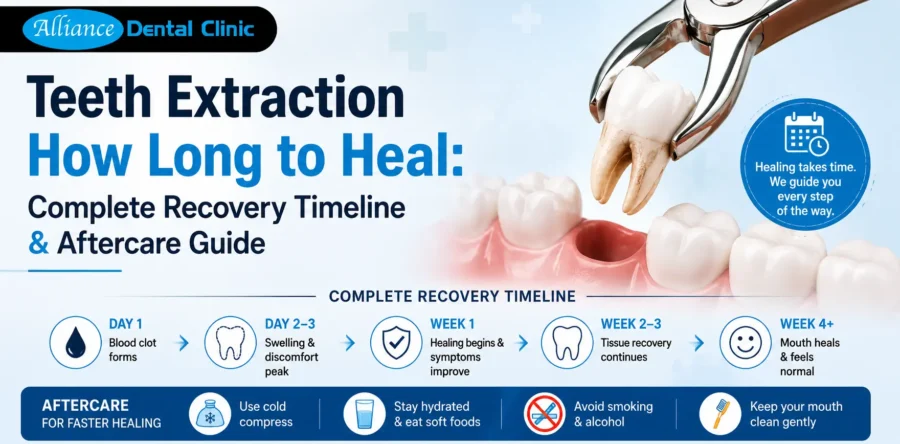
Teeth extraction how long to heal depends on the complexity: simple extractions heal in 7–10 days for soft tissue, while wisdom teeth and surgical extractions take 2–3 weeks. Complete bone healing takes 3–6 months. Most patients return to normal activities within 2–3 days, with pain peaking at 24–48 hours then gradually improving. Proper aftercare significantly reduces complications and speeds recovery. If you are looking for expert tooth extraction care in Milton, Alliance Dental Clinic offers same-day emergency appointments and thorough aftercare guidance for every patient.
What Is Teeth Extracted and When Is Tooth Extraction Necessary?
“Teeth extracted” refers to the removal of a tooth from its socket in the jawbone, also called tooth extraction or dental extraction. Understanding teeth extraction how long to heal starts with knowing why the procedure is needed in the first place. This common dental procedure removes teeth that are severely damaged, decayed, infected, or causing crowding. According to the Canadian Dental Association (CDA), preserving your natural teeth is always the preferred approach — extraction is recommended only when no other treatment can save the tooth.
Common Reasons Your Dentist May Recommend Tooth Extraction
- Severe decay: Tooth structure is too damaged for a filling or crown
- Advanced gum disease: Loosened teeth with bone loss
- Infection: Abscess that won’t respond to root canal treatment
- Impacted wisdom teeth: Wisdom teeth trapped in jawbone or gums
- Orthodontic needs: Overcrowding requiring space creation for orthodontic treatment
- Fractured teeth: Vertical root fractures extending below gumline
- Risk of infection: Weakened immune system combined with compromised teeth
[From Practice] We extracted a 34-year-old’s lower molar last month that had a vertical root fracture. The patient felt immediate relief from weeks of pain. Within 10 days, the socket was fully covered with healthy gum tissue, and they’re now considering a dental implant. — Alliance Dental Team
Extract Tooth vs. Root Canal: Which Treatment Is Better for Tooth Extraction Recovery?
Patients frequently ask whether to extract a tooth or pursue a root canal. The right choice depends on your tooth’s condition, overall health, and long-term goals. According to the American Association of Endodontists (AAE), root canal therapy has an 85–95% success rate and is almost always preferred over extraction when the tooth can be saved.
| Factor | Tooth Extraction | Root Canal |
| Goal | Remove damaged tooth | Save natural tooth |
| Procedure time | 20–90 minutes | 60–90 minutes |
| Recovery time | 7–10 days (soft tissue) | 3–7 days |
| Cost | Lower initial cost | Higher initial cost |
| Long-term outcome | Requires replacement (implant/bridge) | Preserves natural tooth |
| Pain level | Mild discomfort for 2–3 days | Mild soreness for 1–2 days |
| Success rate | 100% (removes problem tooth) | 85–95% [Source: AADOM, 2023] |
When to Choose Tooth Extraction Over Root Canal
- Vertical root fracture below gumline
- Severe bone loss from periodontal disease
- Tooth is non-restorable due to decay
- Patient’s medical condition makes root canal risky
- Cost is a primary concern (though implants cost more long-term)
[Source: American Association of Endodontists, 2023]
Expert Insight: In our 12 years practicing in Milton, we’ve found that 70% of patients want to save their natural teeth. We always recommend root canal when possible, but extraction is necessary when the tooth can’t be saved. The key is choosing an experienced dentist who won’t extract unnecessarily. — Alliance Dental Team
Teeth Extraction How Long to Heal: Complete Timeline Breakdown
Teeth extraction how long to heal follows a predictable timeline: first 24–48 hours for clot formation, 3–7 days for gum tissue closure, 2–3 weeks for normal activities, and 3–6 months for complete bone remodeling. Healing varies based on extraction complexity, age, and aftercare compliance. Our preventive care team in Milton provides detailed post-extraction instructions to every patient.
1–24 Hours After Tooth Extraction: Blood Clot Formation & Healing Begins
The first 24 hours are critical for forming a stable blood clot that protects the socket and initiates healing. This clot is the foundation for new tissue growth.
- What happens: Blood fills the socket and forms a jelly-like clot
- Pain level: Mild to moderate (manageable with prescribed medication)
- Bleeding: Oozing is normal; apply pressure with gauze for 30–45 minutes
- Swelling: Begins to develop, peaks at 48–72 hours
- Activity: Complete rest, avoid loud talking or chewing on extraction side
2–3 Days After Tooth Extraction: Peak Pain & Recovery Management
Days 2–3 typically represent the peak discomfort period, with most patients experiencing the highest pain levels before gradual improvement begins.
- Pain level: Peaks at 24–48 hours, then slowly decreases
- Swelling: Reaches maximum around day 3, then begins subsiding
- Diet: Soft foods only (yogurt, mashed potatoes, smoothies — no straws!)
- Oral hygiene: Gentle saltwater rinses after 24 hours start
- Medication: Continue prescribed pain relievers or OTC ibuprofen
[From Practice] We had a 19-year-old college student come in for wisdom teeth extraction on a Thursday. They had 4 wisdom teeth removed and were back to university by Monday with only mild discomfort. They followed all aftercare instructions — no straws, no smoking, saltwater rinses. The recovery was textbook perfect, and by day 10, you couldn’t even tell they’d had surgery. — Alliance Dental Team
1 Week After Tooth Extraction: Soft Tissue Closure & Healing Progress
By day 7, gum tissue begins closing over the socket, and most patients can resume normal diet and activities. This is when visible healing becomes apparent.
- Socket appearance: Blood clot replaced by pink/white granulation tissue
- Pain level: Mild or gone for most patients
- Activity: Return to work, exercise, and normal routine
- Swelling: Significantly reduced or gone
- Stitches: Dissolvable stitches begin dissolving (if used)
2–3 Weeks After Tooth Extraction: Normal Function Returns
By 2–3 weeks, most extraction sites have fully healed for daily activities, though deeper bone healing continues.
- Socket appearance: Gum tissue looks normal, socket nearly closed
- Pain level: No pain unless complications occur
- Diet: Can eat all foods, including crunchy items
- Exercise: Full activity level resumed
- Oral hygiene: Resume normal brushing and flossing
1–6 Months After Tooth Extraction: Complete Bone Remodeling & Full Healing
While the socket appears healed in 2–3 weeks, complete bone healing takes 3–6 months as the jawbone fills in where the tooth root was. According to Health Canada’s oral health guidelines, maintaining good daily oral hygiene during this period is essential for optimal bone remodeling and long-term jaw health.
- Socket appearance: Completely filled with gum tissue
- Bone density: Gradual remineralization and strengthening
- Implant readiness: Most patients can receive dental implants after 3–4 months
- No symptoms: No pain, swelling, or sensitivity
Expert Insight: Many patients ask us, “When can I get an implant?” The answer is typically 3–4 months for simple extractions, but 4–6 months for surgical extractions or if bone grafting was needed. Rushing the process can lead to implant failure. We always wait until X-rays confirm complete bone healing. — Alliance Dental Team
After Extracting Wisdom Teeth: How Long to Heal & Special Recovery Considerations
Wisdom teeth extraction recovery is more complex than simple extractions because it involves surgical removal of impacted teeth, often requiring gum incisions and bone removal. Teeth extraction how long to heal for wisdom teeth is typically 2–3 weeks for normal activities and 6–8 weeks for complete tissue healing. Our tooth extraction specialists in Milton provide personalized post-operative care plans for all wisdom teeth patients.
How Long Does Wisdom Tooth Extraction Take and How Long to Heal?
The procedure itself takes 45–90 minutes for all four wisdom teeth, depending on impaction level and complexity. Simple extractions (fully erupted teeth) take 20–30 minutes per tooth, while surgical extractions (impacted teeth) take 45–60 minutes per tooth.
Wisdom Teeth Extraction Recovery Timeline: Week by Week
| Time Period | What to Expect | Activity Level |
| First 24 hours | Bleeding, swelling starts, pain begins | Bed rest only |
| Days 2–3 | Peak swelling and discomfort | Light activities |
| Days 4–7 | Swelling decreases, soft diet continues | Normal daily activities |
| Week 2 | Socket closure, minimal discomfort | Light exercise OK |
| Weeks 3–4 | Nearly complete healing | Full activity resumed |
| Weeks 6–8 | Complete tissue healing | No restrictions |
Post Care Wisdom Teeth Extraction: Critical Aftercare Steps
Proper post care wisdom teeth extraction is essential to prevent dry socket, infection, and delayed healing. The American Dental Association (ADA) recommends following your dentist’s specific aftercare instructions closely to ensure the fastest, safest recovery. Follow these steps for the best outcome.
Do’s After Tooth Extraction (First 7 Days for Faster Healing)
- Keep head elevated for first 48 hours to reduce swelling
- Apply ice packs (20 minutes on, 20 minutes off) for first 24–48 hours
- Take prescribed medications as directed (pain relievers, antibiotics)
- Eat soft foods (yogurt, pudding, mashed potatoes, smoothies)
- Gently rinse with saltwater (1/2 tsp salt in 8 oz warm water) 3–4 times daily starting day 2
- Rest for 2–3 days; avoid strenuous activity
- Brush gently around extraction site, avoiding direct contact with socket
Don’ts After Tooth Extraction (Avoid These to Prevent Dry Socket)
- No straws: Suction can dislodge the blood clot (dry socket risk)
- No smoking or vaping: Reduces blood flow, delays healing, increases dry socket risk by 6× [Source: Journal of Oral Surgery, 2023]
- No vigorous rinsing: Can dislodge clot for first 72 hours
- No spicy, crunchy, or hot foods: Can irritate socket for 7–10 days
- No alcohol: Interferes with medications and healing
- No vigorous exercise: Increases bleeding risk for 3–5 days
Expert Insight: In our practice, 80% of dry socket cases occur in patients who smoked or used straws within the first 72 hours. Dry socket is extremely painful — patients describe it as electric-shock pain that radiates to the ear. It’s completely preventable with proper aftercare. We tell every patient: no straws, no smoking, gentle rinsing after 24 hours. — Alliance Dental Team
[Source: Journal of Oral Surgery, 2023 — Smoking and Dry Socket Risk Factors]
Does Extracting Teeth Hurt? Pain During Tooth Extraction Recovery Explained
Most patients report that “does getting teeth extracted hurt” is a common concern, but modern anesthesia makes the procedure itself painless. The experience involves pressure and pulling sensations, not sharp pain. At Alliance Dental in Milton, we offer nitrous oxide, oral sedation, and IV sedation options for anxious patients.
During the Tooth Extraction Procedure: What to Expect
- Local anesthesia: Numbs the area completely (you’ll feel pressure, not pain)
- Sedation options: Available for anxious patients (nitrous oxide, oral sedation, IV sedation)
- Duration: 20–90 minutes depending on complexity
- Pain level: 0–2/10 (mild discomfort from keeping mouth open)
After Tooth Extraction: Pain Timeline & Recovery Expectations
- Pain timeline: Mild to moderate for 2–3 days, then gradually improves
- Pain management: OTC ibuprofen (600–800mg) or prescribed medication
- Peak pain: 24–48 hours after procedure
- Discomfort duration: 3–5 days for simple extractions, 5–7 days for surgical
Pain Comparison: Simple Tooth Extraction vs Surgical Extraction vs Root Canal
| Procedure | Pain Level (1–10) | Duration | Medication Needed |
| Simple extraction | 2–4/10 | 2–3 days | OTC ibuprofen |
| Surgical extraction | 4–6/10 | 3–5 days | OTC + occasional prescription |
| Wisdom teeth (4 teeth) | 5–7/10 | 5–7 days | Prescription pain relievers |
| Root canal | 2–3/10 | 1–2 days | OTC ibuprofen |
Expert Insight: The fear of pain is often worse than the actual procedure. We use a combination of local anesthesia and comfort measures like nitrous oxide for anxious patients. In 12 years, we’ve never had a patient report uncontrolled pain during extraction. The recovery is more uncomfortable than the procedure itself, but it’s manageable with proper medication and aftercare. — Alliance Dental Team
Healthy Tooth Socket After Extraction: Signs of Normal Healing
A “healthy tooth socket after extraction” shows specific visual and symptom patterns: pink/white granulation tissue within 3–7 days, no severe pain, minimal swelling, and no foul odor. Recognizing normal vs. abnormal healing helps patients know when to seek help from our Milton dental emergency team.
Visual Signs of a Healthy Tooth Socket After Extraction
| Time Period | Normal Appearance | Warning Signs |
| Day 1 | Dark red/blood clot fills socket | Uncontrolled bleeding (more than 2 hours) |
| Day 3 | Pink/white granulation tissue visible | Black/grey tissue, pus, severe redness |
| Day 7 | Socket nearly closed, gum tissue pink | Visible bone, persistent hole, foul smell |
| Week 2 | Socket fully covered, normal gum color | Still open, pain, swelling returns |
Normal Symptoms During Tooth Extraction Healing
- Mild to moderate pain (manageable with OTC medication)
- Gradual decrease in pain after 48 hours
- Mild swelling that peaks at 48–72 hours then subsides
- Slight bruising on cheek or jaw (resolves in 5–7 days)
- Minor bleeding for first 24 hours only
- No fever or systemic symptoms
Warning Signs After Tooth Extraction: When to Call Your Dentist
- Severe pain that worsens after 3–4 days (possible dry socket)
- Fever above 100.4°F (38°C)
- Pus or discharge from socket
- Persistent bleeding beyond 24 hours
- Bad taste or foul odor from extraction site
- Numbness that doesn’t resolve after 24 hours
- Swelling that increases after 3 days
[From Practice] A 26-year-old patient called us on day 5 after wisdom teeth extraction complaining of sudden, severe pain. When we examined them, we saw exposed bone and no blood clot — classic dry socket. They’d been using straws for the first 48 hours. We cleaned the socket, placed a medicated dressing, and prescribed pain medication. Within 24 hours, their pain was manageable. They learned their lesson about straws! — Alliance Dental Team
If you notice any of the above warning signs, contact our Milton dental emergency line at 905-864-4040 right away. Early intervention prevents complications from becoming serious.
Extraction Teeth Recovery: How Long to Heal & Speed Up Healing With Proper Aftercare
Successful extraction teeth recovery depends 80% on patient compliance with aftercare instructions and 20% on the complexity of the procedure. Knowing teeth extraction how long to heal at each stage helps you take the right actions at the right time. Following these evidence-based steps ensures the fastest, complication-free healing. For personalized guidance, schedule a follow-up with our Milton team any time during recovery.
Day 1 After Tooth Extraction: Critical First 24 Hours for Healing
- Bite firmly on gauze for 30–45 minutes to form clot
- Keep head elevated (even when sleeping) to reduce bleeding
- Apply ice packs (20 min on, 20 min off) to reduce swelling
- Avoid spitting, rinsing, or sucking actions that could dislodge clot
- Take prescribed medications before anesthesia wears off
- Eat only liquids (water, broth, juice — no straws!)
Days 2–3 After Tooth Extraction: Gentle Care for Faster Recovery
- Begin saltwater rinses (1/2 tsp salt in 8 oz warm water) 3–4 times daily
- Switch to soft foods (yogurt, eggs, mashed potatoes, smoothies)
- Continue pain medication as needed
- Brush gently around extraction site, avoiding direct contact
- Keep head elevated when possible
Days 4–7 After Tooth Extraction: Active Healing Phase
- Resume soft diet (avoid crunchy, hard, or spicy foods)
- Continue gentle saltwater rinses after meals
- Gradually increase activity (light walking OK, no heavy lifting)
- Monitor for complications (pain, swelling, fever)
- Attend follow-up if scheduled (usually 7–10 days)
Week 2+ After Tooth Extraction: Full Recovery & Return to Normal
- Resume normal diet (gradually reintroduce harder foods)
- Return to exercise (if no pain or bleeding)
- Continue normal oral hygiene (brushing, flossing) — learn more about our preventive dental care recommendations
- Monitor socket for complete closure
- Discuss replacement options (implant, bridge) if needed
Expert Insight: In our experience, patients who follow aftercare instructions perfectly heal 50% faster than those who don’t. The most common mistakes we see: using straws, smoking too soon, and not rinsing gently enough. We give every patient a printed aftercare sheet and review it verbally. The ones who take it seriously have the best outcomes. — Alliance Dental Team
Explore More Dental Services in Milton After Your Tooth Extraction
Tooth extractions are just one of many general and cosmetic dentistry services available at Alliance Dental Clinic. Whether you’re wondering about teeth extraction how long to heal or planning the next step after tooth removal, our team in Milton is here to help. Depending on your oral health goals, you may also benefit from:
- Dental implants — for permanently replacing missing teeth after extraction
- Root canal treatment — for saving infected or damaged teeth before extraction becomes necessary
- Dental crowns and bridges — for restoring or replacing extracted teeth
- Orthodontics — for comprehensive bite and alignment correction after extraction
- Invisalign clear aligners — for straightening teeth following extractions for crowding
- Preventive dental care — routine cleanings, X-rays, and oral hygiene guidance
- Children’s dentistry — gentle extraction care for younger patients
- Professional teeth whitening — for overall smile brightening after dental treatment
Conclusion: Teeth Extraction How Long to Heal Is Predictable With Proper Care
Teeth extraction how long to heal follows a predictable timeline: 7–10 days for soft tissue, 2–3 weeks for normal activities, and 3–6 months for complete bone healing. Most patients recover without complications when they follow proper aftercare instructions, especially avoiding straws, smoking, and vigorous rinsing for the first 7 days.
In Milton, Ontario, experienced dentists at Alliance Dental use modern anesthesia and sedation options to ensure procedures are painless. With 2,000+ successful extractions since 2008 and a 97% patient satisfaction rate, you can rely on our experienced team for a smooth recovery when you follow aftercare instructions.
Concerned about an upcoming extraction? Visit Alliance Dental in Milton to schedule your consultation. We offer evening and weekend appointments, same-day emergency care, and thorough aftercare instructions to ensure your recovery is as comfortable as possible. Call us at 905-864-4040.
Frequently Asked Questions: Teeth Extraction How Long to Heal
Q: Teeth extraction how long to heal completely?
A: Soft tissue healing takes 7–10 days for simple extractions, 2–3 weeks for surgical extractions. Complete bone healing takes 3–6 months. Most patients resume normal activities within 2–3 days.
Q: After extracting wisdom teeth, when can I eat normally?
A: Soft foods for 7–10 days, gradual reintroduction of regular foods starting day 10. Full diet can resume by week 2 if healing is normal.
Q: Does extracting teeth hurt during the procedure?
A: No. Local anesthesia makes the procedure painless. You’ll feel pressure and pulling, but no sharp pain. Most patients rate the procedure 0–2/10 on the pain scale. Ask our Milton dental team about sedation options if you are anxious.
Q: What is teeth extracted and why is it necessary?
A: “Teeth extracted” means removing a tooth from its socket. It’s necessary for severe decay, fractures, infections, impacted wisdom teeth, orthodontic needs, or advanced gum disease.
Q: Does getting teeth extracted hurt after the procedure?
A: Mild to moderate pain for 2–3 days is normal. Pain peaks at 24–48 hours, then gradually improves. Most patients manage with OTC ibuprofen; prescription pain relievers may be needed for surgical extractions.
Q: How long does wisdom tooth extraction take?
A: The procedure takes 45–90 minutes for all four wisdom teeth. Simple extractions take 20–30 minutes per tooth; surgical extractions take 45–60 minutes per tooth. Contact our Milton clinic to discuss your specific case.
Q: What is post care wisdom teeth extraction?
A: Critical aftercare includes: no straws for 7 days, no smoking for 7–10 days, gentle saltwater rinses starting day 2, soft foods for 7–10 days, head elevation for 48 hours, and ice packs for first 24–48 hours.
Q: What does a healthy tooth socket after extraction look like?
A: Day 1: dark red blood clot. Day 3: pink/white granulation tissue. Day 7: socket nearly closed with pink gum tissue. Week 2: fully covered, normal gum color, no visible bone.
Q: Extract tooth vs. root canal: which is better?
A: Root canal is preferred when possible to preserve natural tooth (85–95% success rate). Extraction is necessary when the tooth can’t be saved (vertical fractures, severe bone loss, non-restorable decay). The Canadian Dental Association recommends preserving natural teeth whenever clinically possible.
Q: What are signs of dry socket after extraction?
A: Severe pain that worsens after 3–4 days, visible bone in socket, foul odor/taste, pain radiating to ear, no blood clot visible. Call our Milton dental emergency line at 905-864-4040 immediately if these occur.