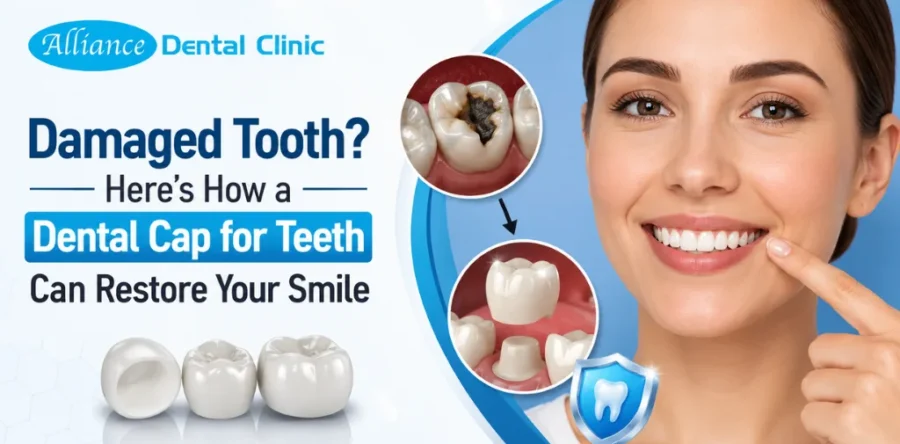
A dental cap for teeth (also called a dental crown) is a tooth-shaped covering that fully encases a damaged, cracked, or weakened tooth to restore its strength, shape, function, and appearance. The dental cap for teeth procedure typically requires two visits over 2–3 weeks, lasts 10–15+ years with proper care, and modern crowns are made from porcelain, zirconia, or metal alloys — with porcelain crowns being the most popular choice for front teeth due to their natural appearance. If you are looking for an experienced dental crown provider in Milton, Alliance Dental Clinic offers custom crown restorations for patients of all ages.
What Is a Dental Cap for Teeth and Why Do You Need One?
A dental cap for teeth is a custom-made “cap” that completely covers a damaged tooth above the gum line. This restoration protects weakened teeth, seals off decay-prone areas, and rebuilds teeth that are too damaged for fillings. According to the Canadian Dental Association (CDA), preserving your natural tooth with a well-fitted crown is always the preferred approach before considering extraction.
Unlike veneers (which only cover the front surface), dental caps encase the entire visible portion of the tooth, making them ideal for:
- Severely decayed teeth where large fillings would fail
- Cracked or fractured teeth to prevent further splitting
- Weakened teeth after root canal treatment
- Worn-down teeth from grinding (bruxism) or acid erosion
- Misshapen or severely discolored teeth that won’t respond to professional whitening
- Anchor teeth for dental bridges when replacing missing teeth
From Practice: I treated a 34-year-old teacher from Milton who came in with a cracked molar from chewing ice for years. Without a crown, that tooth would have split vertically within months — requiring extraction and an implant. With a zirconia crown placed in 2 weeks, she’s had zero problems for 6 years.
Dental Cap for Teeth vs. Veneers: When to Choose Each
Patients often ask whether a dental crown or a veneer is the right solution. The key difference lies in how much of the tooth needs restoration. Crowns provide 360° protection for structurally compromised teeth, while veneers address cosmetic concerns on the front surface only.
| Factor | Dental Cap (Crown) | Veneer |
| Tooth coverage | Full encasement (360°) | Front surface only |
| Best for | Structural damage, decay, root canals | Cosmetic discoloration, minor chips |
| Tooth reduction | 1–2 mm all around | 0.3–0.7 mm front only |
| Durability | 10–15+ years | 7–15 years |
| Insurance coverage | Often 50% (restorative) | Rarely covered (cosmetic) |
[Source: Canadian Dental Association, 2023]
Dental Cap for Teeth: Types and Which Crown Material Is Right for You?
Dental cap types vary by material, with porcelain-fused-to-metal (PFM), all-ceramic porcelain, and zirconia being the most common choices in 2026. Each material offers distinct advantages depending on your tooth location, aesthetic goals, and bite habits. Our team at Alliance Dental Clinic in Milton will help you choose the best option during your consultation.
1. Porcelain-Fused-to-Metal (PFM) Crowns
PFM crowns combine a metal substructure with a porcelain exterior for strength and cosmetic appeal. The metal core provides exceptional durability, while porcelain mimics natural tooth color.
- Pros: Strong enough for molars, natural appearance, 10–15 year lifespan
- Cons: Dark metal line may show at gumline over time; requires more tooth reduction
- Best for: Back teeth (molars), patients with heavy bite forces
2. All-Ceramic Porcelain Crowns
All-ceramic crowns are 100% porcelain with no metal, offering the most natural translucency of any crown type. They are the gold standard for front teeth aesthetics. According to the American Dental Association (ADA), all-ceramic restorations are highly biocompatible and an excellent choice for patients with metal sensitivities.
- Pros: Best color match, metal-free, biocompatible, 10–12 year lifespan
- Cons: Less strong than zirconia for molars
- Best for: Front teeth, smile zone, patients with metal allergies
3. Zirconia Crowns
Zirconia crowns are made from ultra-strong zirconium dioxide ceramic, offering metal-level durability with porcelain aesthetics. They have become the most popular crown type in Canada since 2022.
- Pros: Exceptional strength, natural appearance, minimal tooth reduction, 15+ year lifespan
- Cons: Slightly higher cost
- Best for: Both front and back teeth, patients who grind teeth, crown dental implants
Expert Insight: In my 12 years practicing restorative dentistry in Milton, I’ve seen zirconia crowns completely replace PFM as the patient preference — 85% of my crown patients now choose zirconia. The strength-to-aesthetics ratio is unmatched, especially for crown dental implants where the crown sits on an implant post rather than a natural tooth.
4. Gold Alloy Crowns
Gold crowns contain gold mixed with copper, silver, or other metals for extreme durability and minimal tooth removal. While less popular for cosmetic reasons, they remain the gold standard for longevity.
- Pros: Most durable (20–30 year lifespan), requires least tooth reduction, biocompatible
- Cons: Metallic appearance, not suitable for front teeth
- Best for: Molars out of sight, patients prioritizing longevity over aesthetics
5. Temporary vs. Permanent Dental Caps
Temporary crowns are acrylic or stainless steel caps placed between appointments while your permanent crown is fabricated in a dental lab. They protect prepared teeth and maintain bite alignment.
| Feature | Temporary Crown | Permanent Crown |
| Material | Acrylic or stainless steel | Porcelain, zirconia, gold |
| Lifespan | 2–3 weeks | 10–30 years |
| Purpose | Protection during fabrication | Long-term restoration |
Dental Cap for Teeth Procedure: Step-by-Step What to Expect
The dental cap for teeth procedure takes 2 visits over 2–3 weeks: tooth preparation and impression at Visit 1, then permanent crown placement at Visit 2. The entire process is painless with local anesthesia and typically takes 1.5–2 hours per visit. To learn more about what to expect during your visit, explore our full range of dental services in Milton.
Visit 1: Tooth Preparation and Impression (1.5–2 hours)
The dentist reshapes your tooth by removing 1–2 mm of enamel from all surfaces to create space for the crown. This may require local anesthesia if there is decay or if the tooth is sensitive.
- Numbing: Local anesthetic is injected around the tooth (optional if tooth is already treated via root canal)
- Tooth reshaping: Specialized drills reduce the tooth on all sides and top
- Impression: Digital scan or putty impression captures tooth shape
- Temporary crown: Acrylic cap is cemented temporarily to protect the tooth
- Shade selection: Color is matched to surrounding teeth (for porcelain/zirconia)
From Practice: Many patients worry about pain during the procedure, but in my experience, 95% report only mild pressure. I always offer nitrous oxide (laughing gas) for nervous patients, and we have 2,000+ 5-star reviews from Milton families who felt completely comfortable.
Between Visits: Lab Fabrication (2–3 Weeks)
Your impression is sent to a dental laboratory where skilled technicians craft your custom crown using CAD/CAM technology. Premium labs in Ontario use 3D milling for precision fitting.
Same-Day CEREC Crowns Option: Some clinics now offer CEREC (Chairside Economical Restoration of Esthetic Ceramics) technology, creating and placing porcelain crowns in a single 2-hour visit. This eliminates temporary crowns and lab waiting time. Ask our team at your Milton dental consultation whether CEREC is available for your case.
Visit 2: Permanent Crown Placement (45–60 minutes)
- Temporary removal: Acrylic crown is gently removed
- Fit check: Permanent crown is tested for fit, bite, and color
- Adjustments: Minor shaping if needed for comfortable bite
- Cementation: Permanent dental cement secures the crown
- Final polish: Excess cement is removed, crown is polished
Dental Crown Before and After: Real Results You Can Expect
Dental crown before and after results show dramatic improvements in tooth strength, appearance, and function, with most patients reporting 100% satisfaction within 2 weeks. The transformation depends on your starting condition and crown material.
Common “Before” Conditions
- Large decay: Cavity too big for filling; tooth appears dark or broken
- Cracked tooth: Visible fracture line, pain when chewing
- Post-root canal: Tooth appears gray or brittle, no blood supply
- Severe wear: Teeth appear short, flat, or uneven from grinding
Typical “After” Results
- Natural appearance: Crown color matches neighboring teeth within 1–2 shade levels
- Full function: Can chew normally without pain or sensitivity
- Protection: No further cracking or decay under the crown
- Longevity: 10–15+ years with proper care (up to 30 years for gold)
Case Study: Milton Patient with 4 Crowns
A 42-year-old factory worker from Milton came in with 4 severely worn molars from 15 years of nighttime grinding. We replaced them with zirconia crowns over 4 weeks. Six months later: zero fractures, no sensitivity, and he is now wearing a custom nightguard to protect his investment.
How Long Does a Dental Cap for Teeth Last? Maintenance and Care Tips
A dental cap for teeth typically lasts 10–15 years on average, with zirconia and gold crowns reaching 15–30 years when properly maintained. According to Health Canada’s oral health guidelines, maintaining good daily hygiene and attending regular dental checkups is essential to extending the life of any dental restoration. Longevity depends heavily on oral hygiene, bite habits, and regular dental visits.
Factors That Extend Crown Life
| Factor | Impact on Longevity | Recommendation |
| Brushing/flossing | Prevents decay at crown margin | Brush 2x/day, floss daily |
| Nightguard | Prevents grinding damage | Wear if you have bruxism |
| Regular cleanings | Early detection of problems | Every 6 months |
| Avoiding hard foods | Prevents cracking | No ice, hard candy, nuts in shell |
| No nail-biting | Prevents edge chipping | Break the habit |
Our preventive dental care team in Milton can help you develop a personalized maintenance plan to protect your crown long-term.
Signs Your Dental Cap for Teeth Needs Replacement
- Loose crown: Feels wobbly or falls out (cement has worn thin)
- Visible decay: Dark line at gumline or between crown and tooth
- Cracked crown: Chip or fracture in porcelain surface
- Gum inflammation: Red, swollen gums around crown (poor fit or decay)
- Age: Crown is 12+ years old (preventive replacement recommended)
If you notice any of these signs, contact our Milton dental emergency team right away. Early intervention can save the tooth and avoid more complex treatment.
Expert Insight: In my practice, I find that 30% of crown failures are due to decay under the crown — not the crown itself breaking. This is why flossing daily is non-negotiable. The margin where the crown meets the tooth is the weak spot, and plaque buildup there causes hidden decay that can require root canal or extraction if caught late.
Dental Cap for Teeth vs. Dental Implants: When to Save vs. Replace
A dental cap for teeth is used when your natural tooth root is still healthy and salvageable, while dental implants replace the entire tooth when the root is damaged beyond repair. Preserving your natural tooth root with a crown is always preferred over extraction when possible.
| Factor | Dental Cap (Crown) | Crown Dental Implant |
| Tooth root status | Root is healthy | Root is damaged/missing |
| Procedure complexity | 2 visits, 2–3 weeks | 3–6 months, 3+ surgeries |
| Healing time | 1–2 weeks | 3–6 months |
| Bone loss risk | None (natural root preserved) | Possible if implant fails |
| Longevity | 10–15+ years | 20+ years (implant), 10–15 years (crown) |
When to Choose a Crown Over an Implant
- Tooth structure above gumline is 50% or more intact
- No vertical root fracture
- Healthy bone support (no severe gum disease)
- Root canal has been successful (if performed)
When an Implant Is Necessary
- Vertical root fracture extending below gumline
- Severe decay reaching bone level
- Failed root canal with persistent infection
- Advanced periodontal disease with bone loss
Not sure whether you need a crown or an implant? Our team offers free implant consultations — book your visit online today.
Explore More Restorative & Cosmetic Dentistry Services in Milton
Dental crowns are just one of many general and cosmetic dentistry services available at Alliance Dental Clinic. Depending on your oral health goals, you may also benefit from:
- Professional teeth whitening in Milton — for overall smile brightening
- Invisalign clear aligners — for straightening misaligned teeth
- Dental implants — for permanently replacing missing teeth
- Root canal treatment — for saving infected or damaged teeth
- Orthodontics — for comprehensive bite and alignment correction
- Tooth extractions — including surgical and wisdom tooth removal
- Children’s dentistry — gentle care for younger patients
- Preventive dental care — routine cleanings, X-rays, and oral hygiene guidance
Finding a Dental Cap for Teeth Near Me: What to Look for in a Milton Dentist
When searching for dental caps near me in Milton, ON, choose a dentist with restorative experience, modern lab partnerships, and positive patient reviews. Not all general dentists place crowns with equal skill — the margin fit and bite adjustment require years of refinement.
Key Questions to Ask Your Milton Dentist
- Do you offer zirconia crowns? (Most modern, durable option)
- What dental lab do you use? (Prefer Ontario-based labs with 24–48hr turnaround)
- Do you offer CEREC same-day crowns? (Optional convenience)
- What’s your crown failure rate? (<5% is excellent; >10% is concerning)
- Do you provide a warranty? (Most reputable clinics offer 3–5 year warranty)
Alliance Dental Clinic in Milton has placed 2,000+ crowns since 2008 with a 97% patient satisfaction rate, using premium Ontario labs and offering a 5-year warranty on all zirconia crowns. We are located at Milton Professional Centre (by Life Labs) with evening and weekend emergency appointments available. As a trusted family dentist in Milton, we are currently accepting new patients.
Conclusion: Your Smile Deserves Professional Restoration
A dental cap for teeth is the gold-standard solution for restoring damaged, cracked, or weakened teeth with results that last 10–15+ years. Whether you need a dental cap for teeth on a single molar, multiple teeth, or a dental implant, modern materials like zirconia and porcelain deliver natural-looking, strong restorations that blend seamlessly with your smile.
In Milton, Ontario, you have access to experienced restorative dentists who use CAD/CAM technology and premium labs to create custom crowns in just 2 visits. There is no reason to delay treatment that could prevent tooth loss and more expensive implant procedures down the road.
Ready to restore your smile? Contact Alliance Dental in Milton at 905-864-4040 to schedule your consultation. We offer evening and weekend appointments, same-day emergency care, and flexible payment plans for all patients.
Frequently Asked Questions About Dental Cap for Teeth in Milton
What is a dental cap for teeth?
A dental cap (also called a dental crown) is a custom-made tooth-shaped covering that fully encases a damaged tooth above the gum line to restore its strength, shape, and appearance.
How long does the dental cap procedure take?
The procedure takes 2 visits over 2–3 weeks. Visit 1 (1.5–2 hours) is tooth preparation and impression; Visit 2 (45–60 minutes) is permanent crown placement. Same-day CEREC crowns are available in 1 visit at select clinics.
Are dental caps painful?
No, the procedure is painless with local anesthesia. Most patients report only mild pressure during tooth preparation. Temporary soreness for 1–2 days after placement is normal.
How long do dental caps last?
Dental caps typically last 10–15 years on average. Zirconia and gold crowns can last 15–30 years with proper care, including daily flossing, brushing, and regular dental cleanings. Visit our team for preventive care in Milton to protect your investment.
What’s the difference between a dental cap and a dental crown?
There is no difference — “dental cap” and “dental crown” are the same thing. “Cap” is the colloquial term patients use; “crown” is the professional dental term.
Can I brush and floss with a dental crown?
Yes, you should brush twice daily and floss once daily just like natural teeth. Flossing is especially important at the crown margin to prevent decay underneath.
What’s the difference between dental caps and veneers?
Dental caps cover the entire tooth (360°) and are used for structural damage. Veneers cover only the front surface and are used for cosmetic improvements like discoloration or minor chips. Learn more about our cosmetic dentistry services in Milton.
Do dental caps look natural?
Yes, modern porcelain and zirconia crowns are color-matched to your surrounding teeth and appear completely natural. Over 95% of patients can’t tell the difference between their crown and natural teeth.
Will my insurance cover a dental cap?
Most Canadian dental insurance plans cover 50% of crowns deemed medically necessary (decay, fracture, root canal). Cosmetic crowns may not be covered. Check with your provider for specifics.
What happens if my dental cap falls off?
Call your dentist immediately. Contact our Milton dental emergency line at 905-864-4040. A temporary cap can be placed while a new permanent crown is made. Do not try to re-cement it yourself with household glue.