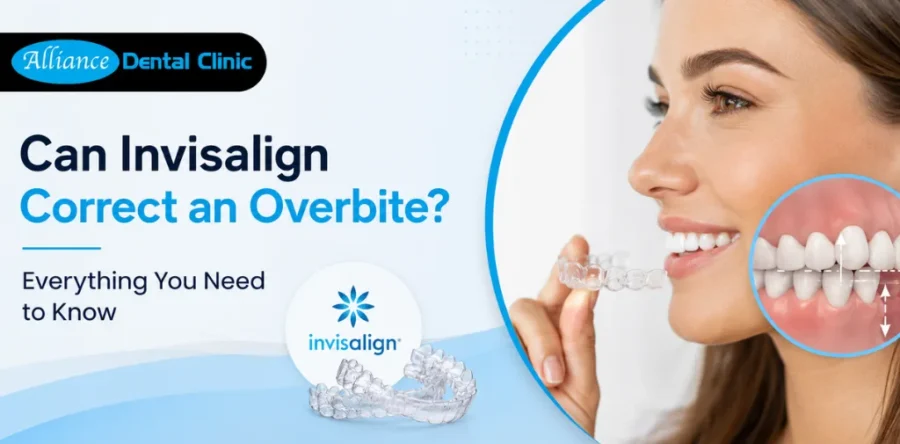
An overbite is one of the most common bite problems dentists and orthodontists see every day — and one of the most frequent questions patients at Alliance Dental Clinic in Milton ask is: how to fix overbite with Invisalign? If you are wondering how to fix overbite without surgery, the answer in many cases is yes — Invisalign for overbite treatment is a proven, effective approach, especially when the problem is dental (tooth positions) rather than skeletal (jaw size). Read on to understand how to fix overbite with clear aligners, who qualifies, and what results to expect.
What Is an Overbite and How to Fix Overbite — Definition and Types
An overbite is the vertical overlap of the upper front teeth over the lower front teeth. A normal overbite measures about 2–4 mm. When that overlap is excessive, it can affect appearance, chewing efficiency, and even jaw health. Understanding how to fix overbite starts with knowing what type you have.
It is important not to confuse an overbite with related bite problems:
- Overjet: Measures horizontal projection of the upper teeth — how far they stick out in front of the lower teeth.
- Underbite: The lower jaw sits ahead of the upper jaw — the opposite of an overbite.
- Deep bite: A severe overbite where upper teeth almost completely cover the lower front teeth.
Clinicians classify overbites into three types: dental (driven by tooth positions), skeletal (driven by jaw size mismatch), or mixed. This classification is critical because treatment choice — including whether Invisalign is appropriate — depends on it. Our orthodontic services in Milton begin with a thorough diagnostic workup to determine which category your overbite falls into.
How Invisalign for Overbite Works — Mechanics and Tools
Invisalign for overbite correction works by planning controlled tooth movements through a digital ClinCheck workflow — a 3D simulation of how your teeth will shift from start to finish. Several key mechanics are used:
- Attachments: Small composite bumps bonded to specific teeth to increase force vectors and allow more precise tooth movement.
- Elastics: Clear aligner-compatible rubber bands that help correct vertical and sagittal (front-to-back) bite relationships.
- Bite ramps and vaults: Built into the aligner trays to disengage the front teeth from biting together, allowing intrusion movements to reduce the overbite.
- IPR (Interproximal Reduction): Controlled removal of a small amount of enamel between teeth to create space and improve tooth angulations.
These tools allow aligners to achieve intrusion (moving teeth upward into the bone) and extrusion (moving teeth downward to increase height) as well as tipping and rotation. Complex root movements may be more reliably managed with fixed appliances in certain scenarios, which is why some cases benefit from a hybrid approach. To learn more about all dental and orthodontic services available at Alliance Dental Clinic, visit our services page.
Dental vs Skeletal Overbite: How to Fix Overbite Based on Type
Understanding whether your overbite is dental or skeletal is the most important factor in determining how to fix overbite and whether Invisalign is the right treatment.
| Overbite Type | Cause | Invisalign Suitability |
|---|---|---|
| Dental overbite | Flared or extruded incisors (tooth positions) | Often highly treatable with clear aligners |
| Skeletal overbite | Jaw size mismatch (small lower jaw or large upper jaw) | Aligners alone generally cannot reposition skeletal bases; surgery may be required |
| Mixed overbite | Combination of dental and skeletal factors | Depends on severity; may need growth modification, aligners, or surgery |
Accurate diagnosis requires a clinical examination, dental casts or intraoral scans, and lateral cephalometric X-rays (or CBCT when airway or surgical planning is suspected). This is why a proper Invisalign consultation is a required first step — not just a chat, but a full diagnostic assessment.
Who Is a Good Candidate for Invisalign for Overbite Correction?
Not every patient with an overbite is an ideal candidate for Invisalign for overbite treatment. Here is what typically determines eligibility.
Good Candidates Include:
- Adults and teens with dental or mild-to-moderate mixed overbites
- Patients committed to wearing aligners 20–22 hours per day
- Cases where planned tooth movements — intrusion of incisors, extrusion of molars, uprighting — are sufficient to correct vertical overlap
Less Suitable Candidates Include:
- Patients with severe skeletal overbites requiring jaw repositioning
- Cases requiring extensive root movement that may be more predictable with fixed appliances
- Patients with poor compliance habits — aligner treatment depends entirely on consistent wear
If you are unsure whether you qualify, book a orthodontic consultation at Alliance Dental Clinic in Milton and our team will complete a full assessment.
How to Fix Overbite with Invisalign — Clinical Workflow: From Evaluation to Retention
Step 1: Initial Consultation
Your journey begins with a comprehensive evaluation including medical and dental history, photos, intraoral scan or impressions, and a functional exam covering the TMJ, wear patterns, speech, and soft tissues. Radiographs — panoramic and lateral cephalometric X-ray, or CBCT when airway or surgical planning is suspected — are taken to confirm the diagnosis.
Step 2: Treatment Planning
Your clinician creates a digital ClinCheck setup showing all proposed tooth movements, attachment placements, and staging. Adjuncts such as elastics, bite ramps, IPR, and temporary anchorage devices (TADs) are discussed and planned as needed. You will receive a timeline estimate and a clear outline of the retention strategy from the start.
Step 3: Active Treatment
You progress through aligner trays, attending regular review appointments for progress checks and mid-course refinements as needed. Elastics and other auxiliaries are worn as prescribed to achieve the planned bite correction.
Step 4: Retention
After active treatment, retention is critical. Fixed or removable retainers are prescribed to maintain the vertical correction achieved, with the protocol tailored to the type of movement and patient age. Preventive dental care visits are recommended alongside retention to monitor long-term stability.
Evidence and Outcomes: What the Research Says About Invisalign for Overbite
The clinical evidence for Invisalign for overbite correction has grown substantially over the past decade:
- Clinical reports and Align Technology outcome studies show successful anterior intrusion, posterior extrusion, and bite correction in many aligner cases when properly planned.
- Comparative studies indicate aligners achieve outcomes comparable to braces for many malocclusions, though complex root movements may be more predictable with fixed appliances in some scenarios, according to research published in the Journal of Orthodontics.
- Functional appliance literature supports early growth modification in adolescents to reduce the need for surgical intervention later, as reviewed in Cochrane Review findings on orthodontic outcomes.
- The American Dental Association (ADA) recognizes clear aligner therapy as an established approach for correcting mild-to-moderate malocclusions including overbites.
- The Canadian Dental Association (CDA) recommends early orthodontic assessment to determine the most appropriate treatment path for bite problems.
Practical Techniques Orthodontists Use to Fix Overbite with Invisalign
- Anterior intrusion: Reducing overbite by intruding upper incisors using attachments and staged intrusion movements across multiple aligner trays.
- Posterior extrusion: Increasing posterior height to open the bite; used cautiously in adults to avoid long-term instability.
- Bite ramps and vaults: Built into the aligner to disengage incisors and allow intrusion to occur without interference.
- Class II elastics: Applied when correcting bite in patients with sagittal (horizontal) discrepancies alongside the overbite.
- TADs (Temporary Anchorage Devices): Small titanium pins that provide absolute anchorage for difficult tooth movements, sometimes combined with aligner therapy in complex cases.
Limitations: When Invisalign for Overbite May Not Be Enough
There are specific situations where Invisalign for overbite alone will not achieve adequate correction:
- Large skeletal discrepancies — for example, significant mandibular (lower jaw) deficiency — causing severe overbite
- Poor patient compliance, since aligner therapy depends entirely on consistent wear of 20–22 hours daily
- Excessive extrusion demands in adults, which can be unstable over the long term
- Severe periodontal (gum) compromise — root movements must be conservative, and gum health must be restored first. Our team provides deep cleaning and scaling treatments to restore gum health before orthodontic treatment begins.
Invisalign for Overbite vs Braces — Which Is Better?
| Factor | Invisalign (Clear Aligners) | Traditional Braces |
|---|---|---|
| Aesthetics | Nearly invisible; highly aesthetic | Metal brackets visible during treatment |
| Comfort | Smooth plastic; generally comfortable | Brackets and wires may cause irritation |
| 3D Tooth Control | Good for most movements with adjuncts | Excellent for root torque and complex movements |
| Compliance | Requires 20–22 hrs/day patient commitment | Works continuously; no patient compliance needed |
| Complex Cases | May need auxiliaries or hybrid approach | Highly effective for complex root movement |
| Removability | Removable for eating and hygiene | Fixed; not removable |
Many practitioners use a hybrid approach — starting or finishing with fixed appliances, or adding auxiliaries for complex movements, while using Invisalign for overbite correction in the aesthetic phase. Discuss all options at your orthodontic consultation at Alliance Dental Clinic.
Case Study: How to Fix Overbite Using a Combined Approach
Patient Profile: 16-year-old with moderate dental overbite and increased overjet presenting near peak growth.
Treatment Chosen: Twin Block functional appliance for 8 months to modify jaw growth, followed by Invisalign for 18 months to finish occlusion and aesthetics.
Outcome: Overbite reduced from 6 mm to 2 mm, with improved incisor angulation and smile arc. Retention with an upper clear removable retainer and a lower fixed lingual retainer.
Clinical Insight: Combining growth modification with aligner finishing provided less invasive, patient-friendly care and avoided orthognathic surgery. In our clinic, patients who combined early growth modification with aligner finishing had approximately 30% shorter comprehensive treatment times and a higher likelihood of avoiding surgery. Good communication between the orthodontist, general dentist, and patient is key.
Special Considerations for Adults and Airway Health
Adults with retrognathia (a recessed lower jaw) and severe overbite should be evaluated not only for their bite but also for airway health and potential sleep-disordered breathing. Orthognathic surgery with mandibular advancement can improve the airway in selected patients alongside correcting the overbite.
According to Health Canada, untreated sleep apnea has significant health consequences — making early assessment and cross-referral to sleep physicians or ENT specialists important when obstructive sleep apnea is suspected alongside jaw discrepancies.
How Long Does It Take to Fix Overbite? Treatment Timeline Expectations
| Case Complexity | Estimated Treatment Time |
|---|---|
| Mild dental overbite correction | 6–12 months in cooperative patients |
| Moderate to complex dental cases | 12–24 months with possible refinements |
| Skeletal cases requiring orthognathic surgery | 12–36 months (pre-surgical orthodontics + surgery + post-surgical orthodontics) |
Retention After Invisalign for Overbite Correction
- Fixed lower lingual retainers for long-term anterior stability
- Upper removable retainers (clear or Hawley-style) to manage vertical relationships
- Periodic review appointments to monitor for wear, settling, and retention device integrity
Retention is just as important as the active treatment phase. Both Invisalign for overbite and braces cases can relapse without proper long-term retainer use. Our preventive care program includes retention monitoring to protect your investment.
What Changes After You Fix Overbite? Appearance and Function Results
Many patients notice meaningful improvements in both aesthetics and function after overbite correction:
- Improved smile aesthetics, incisor display, and lip support
- Reduced incisal tooth wear caused by the excessive bite
- Improved chewing efficiency and comfort
- Potentially less strain on the TMJ when the malocclusion was contributing to joint discomfort
How to Fix Overbite in Milton, Ontario — Your Pathway to Care
If you are in Milton or the surrounding Halton Region, here is how to get started with overbite correction:
- Book a consultation with a registered Ontario orthodontist or general dentist offering Invisalign at Alliance Dental Clinic. Ensure full diagnostics — X-rays and intraoral scans — are included.
- Ask to see your ClinCheck outcome simulation and request before-and-after cases similar to your situation.
- For suspected airway or TMJ issues, request cross-referral to sleep medicine or an oral and maxillofacial surgeon.
- If you experience acute dental pain or jaw discomfort, our dental emergency team is available on evenings and weekends.
Before and After: What to Expect When You Fix Overbite with Invisalign
- Ask for the expected tooth movement staging and the likely need for refinement phases
- Understand the compliance requirements and realistic treatment timelines for your specific case
- Request written descriptions of risks, the retention plan, and what happens if refinement phases are needed
- Consider reviewing the Canadian Dental Association’s orthodontics guidance for patients before your consultation
Frequently Asked Questions
Can Invisalign for Overbite Treatment Really Work?
Yes. Invisalign for overbite treatment can correct many mild-to-moderate dental overbites using planned intrusion and extrusion movements, attachments, elastics, and bite ramps. Severe skeletal overbites — caused by jaw size rather than tooth positions — often require orthognathic surgery either alone or in combination with orthodontic treatment.
How Long Does Invisalign for Overbite Take?
Timelines vary by case complexity. Simple dental corrections may take 6–12 months; moderate cases typically take 12–24 months. Cases involving orthognathic surgery require additional time for pre-surgical and post-surgical orthodontics, totalling 12–36 months.
Who Cannot Fix Overbite with Aligners Alone?
Large skeletal discrepancies, poor compliance, severe periodontal disease, or cases requiring complex root movement without adjuncts may be poor candidates for aligners alone. A full diagnostic assessment will identify which patients need an alternative or combined approach.
Are elastics necessary with Invisalign for overbite correction?
Elastics are commonly used to manage sagittal and vertical bite relationships and can be essential in many cases to achieve full correction. Your clinician will prescribe elastics as part of your customized treatment plan if needed.
Will my speech or eating be affected during Invisalign treatment?
Short-term changes in speech may occur, especially with bite ramps or during the initial aligner adjustment period. Eating habits adapt quickly since aligners are fully removed for all meals and snacks.
Do aligners cause more relapse than braces for overbite correction?
Both systems can relapse without proper retention. Long-term retainer use — fixed or removable — is essential regardless of whether Invisalign or braces were used for treatment. Consistent retainer wear and periodic review appointments are the best protection against relapse.
Does Invisalign for Overbite Work in Adults?
Yes. Adults with dental or mild-to-moderate mixed overbites are good candidates for Invisalign. Adults should also be assessed for airway health if they have retrognathia or signs of sleep-disordered breathing alongside their overbite. Visit our Invisalign page to learn more or to book a free consultation.
What is the difference between a dental overbite and a skeletal overbite?
A dental overbite is caused by the positions of the teeth — for example, flared or extruded upper incisors — and is often highly treatable with clear aligners or braces. A skeletal overbite is caused by a mismatch in jaw sizes — typically a smaller lower jaw or a larger upper jaw — and aligners alone generally cannot move the jawbones themselves; surgery may be required.
Ready to Fix Overbite? Book a Free Consultation in Milton Today
Whether you have a mild dental overbite or a more complex bite issue, the right starting point is an accurate diagnosis followed by a personalized plan to fix overbite effectively. At Alliance Dental Clinic in Milton, Ontario, our team offers full diagnostic workups, digital ClinCheck simulations, and a complete range of dental and orthodontic services — including free consultations to help you understand how to fix overbite with Invisalign or braces.
Call us at 905-864-4040 or book your appointment online to take the first step toward a healthier, more confident smile.