Dr. Kulvinder Hans holds a B.D.S. from Tufts University School of Dental Medicine and is a certified Invisalign provider. He is a member of the Ontario Dental Association, Canadian Dental Association, and American Dental Association. He has been treating underbite and malocclusion cases in Milton since founding Alliance Dental Clinic in 2008. This article reflects his direct clinical experience and is reviewed against current guidelines from the American Association of Orthodontists (AAO).
If you searched “can Invisalign fix underbite in Milton”, you want a direct, clinically honest answer — not a vague page designed to get you to book. This guide delivers exactly that.
After treating underbite patients in Milton for over 15 years, Dr. Hans explains the clear answer — and the one critical distinction that most websites skip entirely.
Quick Answer: Can Invisalign Fix an Underbite?
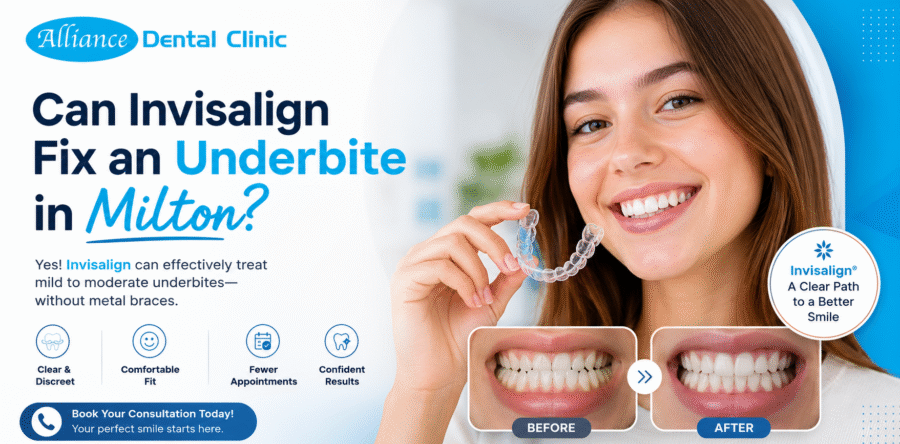
Yes — Invisalign clear aligners can correct mild to moderate dental underbites by repositioning teeth gradually with custom clear aligners. However, underbites caused by jaw structure (skeletal underbite) rather than tooth position require traditional braces, surgical correction, or a combined approach. The only way to know which type you have is a clinical examination with diagnostic imaging.
What Is an Underbite — and Why Does the Cause Matter So Much?
An underbite (clinically known as Class III malocclusion) occurs when your lower teeth protrude in front of your upper teeth when your mouth is closed. It is the opposite of an overbite. Understanding the distinction matters because it directly shapes which treatment will be most effective for you.
The cause of the underbite matters far more than its visual appearance. There are two fundamentally different root causes:
1. Dental Underbite (Tooth-Based)
The jaw bones are correctly positioned relative to each other, but the teeth are angled or positioned in a way that creates the appearance of an underbite. This type responds well to orthodontic treatment — including Invisalign.
2. Skeletal Underbite (Jaw-Based)
The lower jaw (mandible) is structurally longer or positioned further forward than the upper jaw (maxilla). No amount of tooth movement fully resolves this. The jaw itself must be addressed — either through surgical repositioning in adults, or through appliances that guide jaw development in younger patients who are still growing.
Why this distinction matters: A dentist who recommends Invisalign without first determining whether your underbite is dental or skeletal is skipping the most important diagnostic step. Always insist on 3D imaging or cephalometric X-rays before committing to any treatment plan.
Types of Underbite by Severity
Underbites are classified into three categories based on severity. A mild underbite involves slight misalignment with minimal functional impact — Invisalign is typically appropriate. A moderate underbite creates noticeable bite issues affecting chewing and jaw comfort — Invisalign is possible for dental causes, but braces may be preferred where skeletal involvement is present. A severe underbite is typically a skeletal condition involving the jaw itself and often requires surgical correction in adults.
Why Correcting an Underbite Matters Beyond Cosmetics
Left untreated, an underbite is not merely a cosmetic concern. According to the American Association of Orthodontists, untreated bite problems contribute to a range of functional issues that worsen over time. Patients with uncorrected underbites frequently experience chronic jaw muscle tension and facial pain, TMJ (temporomandibular joint) dysfunction, difficulty chewing food efficiently, speech challenges including lisps or articulation difficulties, accelerated long-term tooth wear due to abnormal contact between upper and lower teeth, and sleep disruption linked to altered jaw positioning. Addressing an underbite early — before wear and jaw strain accumulate — consistently leads to simpler, more effective treatment outcomes.
When Invisalign Works Best for an Underbite
Invisalign clear aligners are most effective for underbite correction when the root cause is dental rather than skeletal. Specifically, Invisalign works well when the underbite is mild to moderate in severity, when the misalignment is caused by the position of the teeth rather than the structure of the jaw, when the patient is committed to wearing aligners consistently for 20–22 hours per day, and when the teeth and supporting bone are healthy enough to support gradual movement.
How Invisalign Corrects an Underbite
Invisalign uses a sequence of custom-fabricated, removable clear trays — each designed to apply precise, incremental pressure to move teeth gradually into their target positions. For underbite correction specifically, the aligners work by moving the lower front teeth backward toward their correct position, bringing the upper front teeth forward to create proper overlap, and using Invisalign’s ClinCheck® digital treatment planning software to coordinate these movements in the most efficient sequence. Patients can see a virtual simulation of their projected result before treatment begins. A 2020 review published in the Journal of Clinical Orthodontics confirmed clear aligner therapy to be effective for mild-to-moderate Class III correction in appropriate dental cases (Lombardo et al., 2020).
When Invisalign May Not Be Enough
If your underbite is caused by a structural jaw discrepancy — meaning the upper and lower jaws are significantly different in size or position — clear aligners alone will not fully correct it. Aligners move teeth; they do not reposition the jaw itself. In these cases, a different or combined approach is required.
According to the American Association of Orthodontists, skeletal bite issues typically require more advanced correction beyond what tooth movement alone can achieve. Depending on the degree of jaw involvement, your treatment options may include:
- Traditional metal or ceramic braces — greater mechanical precision for complex tooth movements
- Orthognathic surgery (jaw surgery) — repositions the upper and/or lower jaw; performed in coordination with orthodontic preparation before and after the procedure
- Combined orthodontic and surgical approach — the most common path for severe adult skeletal underbites
- Growth modification appliances — for children and adolescents whose jaws are still developing; can sometimes prevent the need for surgery later in life
The important point is that this distinction — dental versus skeletal — cannot be determined without a clinical examination and proper diagnostic imaging. An honest provider will tell you clearly which situation applies to you before any treatment begins.
Invisalign vs. Braces for Underbite: Which Is Right for You?
Both Invisalign and traditional braces are effective orthodontic tools — but they are not interchangeable for every case. The right choice depends entirely on the nature and severity of your underbite.
| Factor | Invisalign | Traditional Braces |
|---|---|---|
| Best for | Mild–moderate dental underbite | Moderate–severe or skeletal underbite |
| Visibility | Nearly invisible | Visible brackets and wires |
| Comfort | Smooth plastic, no sharp edges | Brackets can irritate soft tissue |
| Removable? | Yes — for eating and brushing | Fixed 24/7 |
| Mechanical precision | Good for dental cases | Greater control for complex movement |
| Oral hygiene | Easier — remove aligners to brush | Requires extra care around brackets |
| Treatment duration | 6–18 months (dental underbites) | 12–30 months (varies widely) |
| Compliance required | 20–22 hours per day | Fixed — no compliance issue |
Clinical bottom line: Invisalign is the better choice for eligible patients — more comfortable, more discreet, and equally effective for dental underbites. For complex or skeletal cases, braces provide the mechanical advantage required. This decision must always follow a clinical diagnosis, not patient preference alone.
At Alliance Dental Clinic in Milton, we assess each patient individually and recommend the approach that is genuinely most appropriate for your specific situation — not simply the most popular or most profitable option.
Can an Underbite Be Fixed Without Surgery?
Yes — the majority of patients with underbites are able to achieve excellent correction without surgery. Non-surgical options including Invisalign, traditional braces, and orthodontic elastics are effective for the full range of dental underbites and for many moderate skeletal cases, particularly when treatment begins earlier in life before skeletal development is complete.
Surgery is generally reserved for severe skeletal underbites in adults where jaw position cannot be adequately addressed through orthodontics alone. If surgical correction is indicated, it is performed in coordination between your orthodontist and an oral and maxillofacial surgeon, with orthodontic treatment both before and after the procedure to optimise the result.
For children and teenagers whose jaws are still developing, early intervention with growth-modification appliances — such as palatal expanders or reverse-pull facemasks — can sometimes correct the jaw relationship entirely, eliminating the need for surgery in adulthood. This is one of the strongest arguments for early orthodontic assessment in young patients.
A straightforward consultation at Alliance Dental Clinic will quickly clarify whether your case is surgical or non-surgical — eliminating uncertainty and allowing you to move forward with a clear treatment plan.
How Underbite Treatment Works in Milton: Step by Step
Step 1: Comprehensive Consultation and 3D Digital Scan
Your treatment begins with a full clinical assessment. At Alliance Dental Clinic, we use advanced iTero digital scanning technology to capture precise three-dimensional images of your teeth, bite relationship, and jaw anatomy. This allows us to definitively classify your underbite as dental or skeletal, identify its severity, and determine which treatment will produce the best outcome for your specific case — before any commitment is made.
Step 2: Personalised Digital Treatment Plan
If Invisalign is appropriate for your case, we use Invisalign’s ClinCheck® digital planning software to map the complete sequence of tooth movements from your current bite to your final corrected position. You will see a simulation of your projected result before a single aligner is fabricated. Every tray in the series is custom-made for your anatomy.
Step 3: Active Treatment Phase
You wear each set of aligners for approximately one to two weeks before progressing to the next set in the series. Regular check-in appointments — typically every six to eight weeks — allow us to monitor your progress and make any necessary adjustments. Consistent wear of 20–22 hours per day is essential to keep treatment on schedule.
Step 4: Retention Phase
Once active treatment is complete, a custom retainer is prescribed to maintain your corrected bite position permanently. This step is non-negotiable — teeth have a natural tendency to shift back toward their original positions without ongoing retention. Skipping this phase is the most common reason patients lose the results of their orthodontic investment.
What to Expect: Timeline and Results for Milton Patients
For patients with a mild dental underbite, Invisalign treatment typically produces meaningful, visible improvement within six to twelve months. Moderate cases generally take twelve to eighteen months. Beyond the functional benefit of a corrected bite, patients most commonly report significant improvement in smile aesthetics and facial profile, relief from jaw tension and chronic discomfort, improved chewing efficiency, and greater confidence in social and professional settings.
Consistency is the most important variable under your control. Patients who wear their aligners as directed consistently achieve their projected outcomes. Those who do not often find treatment extended or results compromised.
Final Verdict: Is Invisalign Right for Your Underbite?
The answer depends on the nature of your underbite. Invisalign is the right solution for mild to moderate underbites where the issue is primarily dental. A combination approach may be appropriate where some skeletal involvement is present but surgery is not required. Invisalign alone is not sufficient for severe jaw misalignment — in those cases, surgical correction remains the most reliable path to a stable, functional result.
The most important step is getting a professional evaluation that gives you a clear, honest answer specific to your anatomy — not a generic response based on what you can read online. If you are in Milton and want to know exactly where your underbite falls on this spectrum, a consultation at Alliance Dental Clinic will give you that clarity.
Why Choose Alliance Dental Clinic for Invisalign in Milton?
Alliance Dental Clinic has been providing evidence-based dental and orthodontic care to the Milton community since 2008. Here is what sets our approach to Invisalign and underbite correction apart from other providers.
- Invisalign Certified Provider: We use the full suite of Invisalign digital tools, including precise iTero 3D scanning and ClinCheck® outcome simulation, to plan treatment with accuracy and transparency before a single aligner is fabricated.
- Personalised underbite correction strategies: We do not apply a one-size-fits-all protocol. Every treatment plan is designed around the specific characteristics of your bite, your anatomy, and your goals.
- Honest clinical guidance: If Invisalign is not the right tool for your underbite, we will tell you — and explain clearly what alternative or combined approach will serve you better.
- Comprehensive orthodontic options: Our orthodontic services include both Invisalign and traditional braces, so we recommend the genuinely best option for your case rather than simply the option we prefer.
- Transparent pricing: We provide a clear cost estimate before treatment begins and help you understand your insurance coverage and available payment options.
- Convenient scheduling: Evening and Saturday appointments available for working adults and families across Milton.
- Trusted by the Milton community: 4.8-star Google rating based on verified patient reviews since 2008.
Ready to Find Out If Invisalign Can Fix Your Underbite?
If you are dealing with an underbite and want a discreet, comfortable solution, the best next step is a professional evaluation. Whether Invisalign is the right fit or a different approach is needed, the team at Alliance Dental Clinic will give you a clear, honest answer and a personalised treatment plan. Book your Invisalign consultation at Alliance Dental Clinic today or call us at 905-864-4040.
Frequently Asked Questions: Can Invisalign Fix an Underbite?
Can Invisalign fix an underbite completely?
Yes — for mild to moderate dental underbites, Invisalign can achieve complete correction. Severe skeletal underbites — where the jaw itself is structurally mispositioned — may require surgery in addition to or instead of aligner therapy. A diagnostic consultation with imaging is the only reliable way to determine which situation applies to you.
How long does Invisalign take for an underbite?
Treatment duration typically ranges from six to eighteen months depending on the severity of the underbite and how consistently aligners are worn. Mild cases can show significant improvement in as little as six to twelve months. Your clinician at Alliance Dental Clinic will provide a specific timeline estimate after reviewing your 3D diagnostic scan.
Is Invisalign better than braces for an underbite?
Invisalign is more comfortable and far less visible than traditional braces, which makes it the preferred choice for mild to moderate underbites where aligners can achieve the necessary tooth movement. For more complex or severe cases — particularly those with a skeletal component — traditional braces offer greater mechanical control and are generally the more effective option. The right choice depends entirely on your specific clinical diagnosis.
Can adults in Milton use Invisalign for an underbite?
Yes. Invisalign is highly effective for adult orthodontic treatment with no upper age limit, provided the teeth and supporting bone are healthy. It is particularly popular with adult patients in Milton who want to correct their bite without the visibility of traditional braces.
Does Invisalign move the jaw?
No. Invisalign moves teeth — it does not reposition the jaw itself. If your underbite involves a significant jaw discrepancy, clear aligners alone will not fully address it. Jaw correction in adults requires surgical intervention. In children and adolescents whose jaws are still developing, specialised growth-modification appliances can sometimes achieve jaw correction without surgery.
Can an underbite be fixed without surgery?
Yes — and for most patients, it can be. The majority of underbites are dental in origin and are fully correctable with Invisalign or traditional braces alone. Surgery is generally reserved for severe skeletal underbites in fully grown adults where orthodontic treatment alone cannot achieve a stable, functional result. A consultation with diagnostic imaging will quickly clarify whether your case is surgical or non-surgical.
What is the difference between an underbite and an overbite?
In a normal bite, the upper teeth slightly overlap the lower teeth. An overbite means the upper teeth overlap the lower teeth excessively — more than is considered ideal. An underbite is the opposite: the lower teeth protrude in front of the upper teeth when the mouth is closed. Both conditions can be corrected orthodontically, but the treatment approaches differ based on the direction of misalignment and whether the root cause is dental or skeletal.