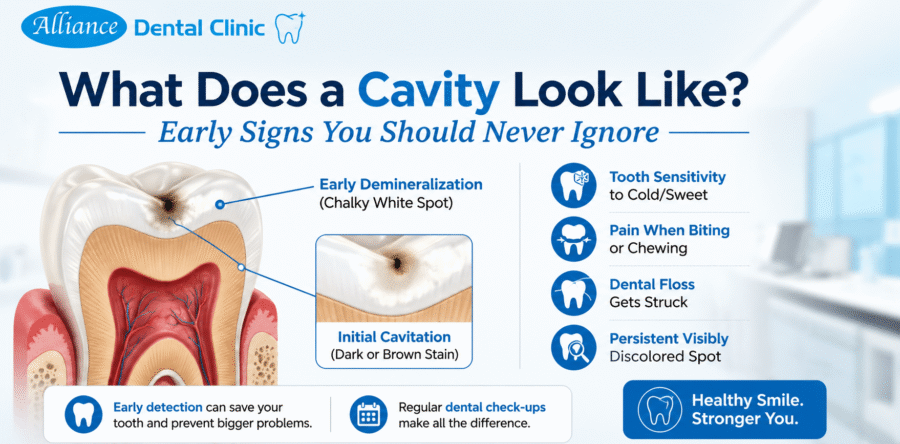
You brush your teeth every day, maybe even floss regularly — yet something still feels off. There is a slight sensitivity when you sip your morning coffee, a dull ache when you chew on one side, or you noticed something that looks like a dark spot the last time you smiled in the mirror. Now you are asking yourself: what does a cavity look like, and could I already have one?
The answer might surprise you. Cavities do not always announce themselves with dramatic pain. In fact, many people live with early tooth decay for months without realizing it. The good news? If you catch them early, treatment is simpler, faster, and far less expensive. That is why knowing how to recognize the signs — visually and physically — can genuinely save your teeth.
This guide breaks down everything you need to know about what cavities look like at every stage, what they feel like, and how to take action before a small problem becomes a serious one. If you are already concerned about what you are seeing or feeling, the team at Alliance Dental Clinic in Milton is here to help.
What Does a Cavity Look Like? A Visual Guide by Stage
Cavities do not appear overnight. They develop in progressive stages, each with its own visual and physical characteristics. Understanding these cavity stages helps you spot trouble before it escalates.
Stage 1: The White Spot — Early Demineralization
The very first sign of a cavity is often a chalky white or opaque spot on the tooth surface. At this stage, acid produced by bacteria has begun to leach minerals from the enamel, but the surface has not yet broken down. These white spots are most commonly found near the gum line or between teeth.
What does a cavity look like when it first starts? It looks like a dull, whitish patch that does not reflect light the way healthy enamel does. You might not feel anything at all at this point, but your dentist can detect it during a routine preventive dental examination.
This is also the only stage where a cavity can potentially be reversed with proper fluoride treatment and improved oral hygiene. According to the American Dental Association (ADA), early-stage demineralization can often be halted or reversed before a full cavity develops.
Stage 2: Enamel Decay — Small but Visible
As the process continues, the white spot begins to turn brown or yellow. The enamel starts to physically break down, and a small pit or depression may form on the tooth surface. This is what a small cavity looks like — a discolored spot, often tan, brown, or yellowish, that may have a slightly rough texture when explored with your tongue.
At this stage, the cavity is entirely within the enamel. Sensitivity may begin, especially to sweet foods or temperature changes, but pain is often still minimal. A simple dental filling at Alliance Dental can address this effectively before it advances further.
Stage 3: Dentin Decay — Things Are Getting Serious
Once decay breaks through the enamel and reaches the dentin — the softer layer beneath — it progresses much faster. What does a cavity look like at this stage? The discoloration deepens, often appearing dark brown or black, and the hole becomes more visible. On a molar, you might notice a dark pit inside the natural grooves of the tooth.
What does a cavity look like on a molar specifically? Molars have deep fissures and grooves where bacteria and food particles collect. Decay in molars often appears as a dark shadow or staining within those grooves, sometimes expanding into a visible hole. Many people describe feeling the cavity with their tongue at this stage — a small indentation or rough spot that was not there before.
Stage 4: Pulp Involvement — Pain Sets In
When decay reaches the pulp — the innermost layer of the tooth containing nerves and blood vessels — the pain becomes hard to ignore. The tooth may throb, ache persistently, or be extremely sensitive to pressure and temperature. Visually, what does a bad cavity look like at this stage? The tooth may have visible dark discoloration, a large hole, or even appear structurally compromised. The surrounding gum tissue might also look inflamed or swollen.
At this stage, a root canal treatment is typically required. Waiting longer can result in abscesses, infection, and tooth loss. If you are experiencing this level of pain, this is a dental emergency — contact Alliance Dental immediately.
What Color Is a Cavity? Understanding the Spectrum
One of the most common questions people have is about cavity color. Here is what to look for:
- White or chalky: Early-stage demineralization — often reversible
- Yellow or light brown: Early to moderate enamel decay
- Dark brown: Moderate to advanced dentin involvement
- Black: Deep decay, often involving the pulp or structural collapse
- Grey shadow beneath the surface: Decay spreading under the enamel — often visible in front teeth as a shadowy discoloration behind the tooth surface
It is worth noting that not all dark spots are cavities. Old dental staining from coffee, tea, or tobacco can mimic the appearance of decay. Similarly, some naturally darker pits in molars are not cavities at all. This is why professional diagnosis matters — visual inspection alone, while helpful, is not a substitute for a dental examination and X-rays at our Milton dental clinic.
What Does Cavity Pain Feel Like?
Pain is often what drives people to the dentist, but cavity pain can be deceptive. Here is how it typically presents:
Sharp, Sudden Sensitivity
This is often triggered by hot, cold, or sweet foods and drinks. It comes quickly and fades within seconds to minutes.
Lingering Ache
If the sensitivity lasts more than a few seconds after the stimulus is removed, this suggests the nerve may be involved.
Spontaneous Throbbing
Pain that occurs without any trigger often signals advanced decay or pulp involvement.
Pain When Biting
Discomfort when you chew or bite down can indicate a cavity in the biting surface of a tooth.
Dull Background Ache
Some people experience a low-level, persistent ache that they adapt to without realizing its source.
What does a cavity feel like when it first starts? In most cases, you feel nothing at all. Early cavities are entirely painless. This is one of the most important reasons why regular preventive dental checkups matter so much — a dentist can identify and treat decay before you ever feel a thing. The Canadian Dental Association (CDA) recommends regular checkups as the cornerstone of good oral health.
Can you feel a cavity with your tongue? Sometimes, yes. Once a cavity has progressed to form a physical pit or rough spot on the tooth surface, many people notice a change in texture when running their tongue across the tooth. However, early cavities and those between teeth are rarely detectable this way.
Can You Have a Cavity and Not Know It?
Absolutely — and this is extremely common. Studies in dental health consistently show that many adults have untreated cavities without being aware of them. Because early-stage cavities cause no pain and may not be visible without a dental mirror or X-ray, they often go undetected until they have progressed significantly.
This is particularly true for:
- Cavities between teeth (interproximal decay), which are virtually invisible to the naked eye
- Early-stage cavities on the biting surfaces of molars, hidden inside narrow grooves
- Cavities beneath existing dental work, such as old fillings or dental crowns
- Cavities near the gum line, often obscured by gum tissue
The takeaway here is clear: the absence of pain does not mean the absence of a problem. Routine dental visits — typically every six months — are the only reliable way to catch cavities at their earliest and most treatable stages. Health Canada also supports regular dental checkups as part of overall preventive health care. Learn more about oral health from Health Canada.
How to Check for Cavities at Home
While professional diagnosis is essential, a basic self-check at home can help you stay aware of changes in your oral health. Here is what to do:
- Use good lighting and a small mirror to inspect all tooth surfaces, including the backs of your molars.
- Look for any spots that appear different in color from the rest of the tooth — white chalky patches, brown spots, or dark areas.
- Run your tongue over all tooth surfaces and note any rough patches, pits, or holes.
- Notice any sensitivity when eating or drinking, especially anything very hot, cold, or sweet.
- Be aware of any persistent bad breath or unusual taste that does not resolve with brushing.
Important: Even if your home check reveals nothing concerning, this does not rule out cavities. Many forms of decay are simply not visible or detectable without professional tools. A home check supplements but never replaces a dental visit at Alliance Dental Clinic.
What Does Tooth Decay Look Like Compared to Normal Staining?
This is a distinction that confuses many people. Here is a practical breakdown:
Tooth Staining (Not a Cavity)
- Surface discoloration from coffee, tea, wine, or tobacco
- Uniform yellowing across multiple teeth
- Staining that is on the surface and can be polished away
- No associated sensitivity or pain
- No change in tooth texture
Tooth Decay (Cavity Signs)
- Localized dark spot or hole on a specific tooth
- Chalky white patch that does not polish away
- Visible pit or indentation in the tooth surface
- Change in texture — rough, soft, or cratered
- Sensitivity to temperature, sweetness, or pressure
When in doubt, see a dentist. The distinction matters enormously for treatment — staining requires teeth whitening or cleaning; decay requires intervention such as a filling or, in advanced cases, a root canal.
Cavities on Different Types of Teeth
What Does a Cavity Look Like on a Molar?
Molars are the most cavity-prone teeth in your mouth. Their deep grooves and fissures create ideal hiding places for bacteria and food. On a molar, cavities typically begin in these grooves, presenting as a dark stain or shadow. As decay advances, the groove opens into a visible hole. Cavities between molars are generally not visible to the naked eye and require X-rays for detection. Our Milton dental services include low-dose digital radiography specifically designed for accurate early detection.
What Does a Cavity Look Like on a Front Tooth?
Front teeth develop cavities less frequently but are often more noticeable when they do. Cavities on the front of these teeth may appear as white spots or brown marks. Cavities between front teeth are especially common in people who do not floss and often present as a dark shadow visible when viewed from certain angles.
What Does a Cavity Look Like on a Baby Tooth?
Children’s teeth are thinner and more susceptible to rapid decay. Early childhood cavities often begin as white spots near the gum line, progressing to brown or black discoloration quickly. They can appear on any surface and sometimes affect multiple teeth simultaneously, particularly in children who drink sweetened liquids frequently. Our children’s dentistry team at Alliance Dental is trained to handle young patients with care and make checkups comfortable and stress-free.
Concerned About What You Are Seeing?
If you have noticed any of the signs described above — or even if you are just due for a checkup — the team at Alliance Dental Clinic is here to help. Early intervention is always the most effective and least invasive approach. Do not wait for pain to tell you something is wrong. Schedule a comprehensive dental examination today and get ahead of any problems before they become costly ones.
Frequently Asked Questions
What does a cavity look like?
A cavity can look different depending on its stage. Early cavities often appear as white or chalky spots on the tooth surface. As they progress, they typically turn yellow, brown, or black, and may develop into a visible hole or pit. Early cavities between teeth or beneath the enamel surface may not be visible at all without dental X-rays.
What does a cavity look like on a tooth?
On a tooth surface, a cavity typically appears as a discolored spot — ranging from white to brown to black — that may have a rough or pitted texture. On the biting surface of a back tooth, it often looks like a dark spot inside the natural groove. Between teeth, it usually cannot be seen without professional imaging.
What does a cavity look like on a molar?
On a molar, cavities usually begin in the deep grooves and fissures on the biting surface, appearing as dark brown or black staining or a visible pit. They can also form between molars, where they are only detectable with X-rays. Molar cavities progress quickly due to the high pressure these teeth endure during chewing.
What does a cavity look like when it first starts?
When a cavity first starts, it looks like a dull, opaque, or chalky white spot on the tooth surface. There is no hole yet, and there is usually no pain. This early stage, called demineralization, is the only point at which cavity development can potentially be reversed with fluoride treatment and improved oral hygiene.
What does a small cavity look like?
A small cavity typically looks like a subtle discolored spot — often tan, light brown, or slightly darker than the surrounding tooth. It may have a faintly rough texture. At this early stage, the cavity is confined to the enamel or just beginning to enter the dentin, and treatment is straightforward — usually a simple filling.
Can you see a cavity just by looking at it?
Sometimes — but not always. Cavities on visible tooth surfaces that have progressed to the dentin stage or beyond are often visible as dark spots or holes. However, many cavities — including early-stage decay, cavities between teeth, and decay under existing dental work — are completely invisible to the naked eye and can only be detected through a professional dental exam and X-rays.
Can you have a cavity and not know it?
Yes, absolutely. Early cavities cause no pain and may have no visible signs that you can detect at home. This is why regular dental checkups at Alliance Dental are essential. Your dentist can identify decay in its earliest stages using visual examination, dental probes, and X-rays — often well before you experience any symptoms at all.
The Bottom Line
Knowing what a cavity looks like — and what it feels like — puts you in a stronger position to protect your teeth. From the subtle white spot of early demineralization to the dark, painful hole of advanced decay, every stage has its own visual and sensory signature. The common thread across all of them is this: earlier detection always means easier, cheaper, and less invasive treatment.
Do not rely on pain alone as your warning signal. Be proactive. Check your teeth regularly, pay attention to changes in sensitivity or texture, and keep your professional dental appointments. Your future self — and your wallet — will thank you.
For personalized dental care and expert cavity detection, visit Alliance Dental Clinic — where your oral health is always the priority. Explore our full range of general and cosmetic dentistry services in Milton, or learn more about how we approach family dentistry for patients of all ages.