Missing teeth can affect far more than just your smile. They can impact chewing ability, speech clarity, facial structure, and overall confidence. At Alliance Dental Clinic in Milton, Ontario, our team recommends dental implants because they offer one of the most reliable and long-lasting tooth replacement solutions in modern dentistry.
What Are Dental Implants and Why Are They Needed?
If you are wondering what dental implants are and whether they might be right for you, you are not alone. Dental implants are one of the most advanced and permanent solutions available for replacing missing teeth.
When a tooth is lost due to decay, injury, or extraction, an implant replaces both the root and the visible crown — restoring full function and natural appearance. The Canadian Dental Association recognizes dental implants as a leading tooth replacement option due to their long-term stability and ability to preserve jawbone health.
What Is a Dental Implant?
A dental implant is a small, biocompatible titanium post surgically placed into the jawbone to replace the root of a missing tooth. Once the implant integrates with the bone through a process called osseointegration, it supports a crown, bridge, or denture — closely mimicking the look and feel of a natural tooth.
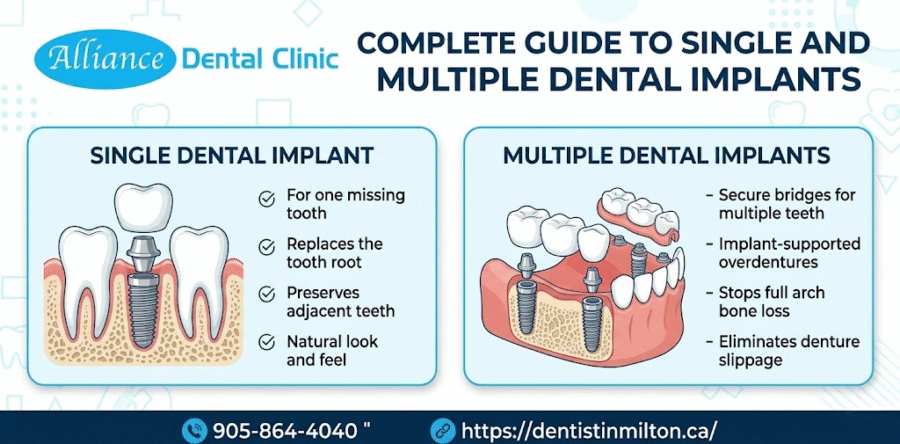
Dental implants consist of three components: an implant post placed inside the jawbone, an abutment that connects the implant to the restoration, and a dental crown — the custom-made visible tooth on top. Together, they form a complete, stable, and natural-looking tooth replacement.
Signs You May Be a Candidate for Dental Implants
1. One or More Missing Teeth
Whether you have lost a single tooth or multiple teeth, implants can restore function and appearance without affecting surrounding healthy teeth.
2. Tooth Extracted Due to Decay or Damage
If a tooth was recently extracted or needs removal, an implant may be placed to fill the gap and prevent bone loss. In some situations, same-day extraction and implant placement is possible depending on bone quality and oral health conditions.
3. Following Root Canal Treatment
In cases where a tooth cannot be saved even after root canal treatment, an implant provides the most stable long-term replacement option.
4. Loose or Uncomfortable Dentures
Patients who find removable dentures uncomfortable or unstable often benefit greatly from implant-supported dentures, which stay securely fixed in the mouth.
5. Bone Loss in the Jaw
When a tooth is missing, the jawbone beneath it begins to deteriorate over time. Implants stimulate the bone just like natural tooth roots, helping to preserve facial structure. Consistent preventive dental care can help identify early signs of bone loss and guide timely treatment decisions.
6. Desire for a Permanent Solution
Unlike removable dentures or temporary restorations, dental implants are a long-term investment in oral health. For patients looking for a comprehensive restoration plan, our dental services in Milton include a full range of restorative and cosmetic treatments that can be combined with implant placement.
Single vs. Multiple Dental Implants
Dental implants can replace one tooth or many, depending on the patient’s needs. A single dental implant replaces one missing tooth without affecting adjacent teeth — unlike a traditional bridge, which requires grinding down neighbouring teeth for support.
For patients missing several teeth, multiple implants can support implant-supported bridges, partial dentures, or full-arch restorations. Rather than placing one implant per tooth, implants are strategically positioned to anchor a restoration that restores full chewing function. You can learn more about our dental implant treatments and the options available for your specific situation.
Dental Implants for Molars and Front Teeth
Molars handle the strongest chewing forces in the mouth. Implants for molars provide strong, stable support and prevent neighbouring teeth from shifting into the gap — a common issue when a molar is left unreplaced for an extended period.
For front teeth, aesthetics are naturally the primary concern. With modern digital planning and high-quality ceramic or porcelain crowns, implants for front teeth blend seamlessly with surrounding teeth in colour, shape, and gum alignment — delivering a confident, natural-looking smile.
Dental Crowns and Implants: How They Work Together
A dental crown is a key component of every implant restoration. Once the implant post has fully integrated with the jawbone, a custom crown is placed on top to restore the visible portion of the tooth. These crowns are designed to match surrounding teeth in colour, shape, size, and bite alignment. Common materials include porcelain and zirconia — both known for their durability and natural appearance. You can learn more about dental crowns and bridges and how they are used as part of a complete restorative plan.
Types of Dental Implant Restorations
- Single Tooth Implant — Replaces one missing tooth with an implant post and custom crown. Does not affect neighbouring teeth.
- Implant-Supported Bridge — Anchored to implants rather than natural teeth, replacing multiple adjacent missing teeth with greater stability.
- Implant-Supported Dentures — Full or partial dentures secured by implants, eliminating slippage and improving comfort.
- All-on-4 Implants — A full-arch restoration supported by four strategically placed implants, often completed in fewer visits.
- Immediate Implant Placement — In suitable cases, an implant is placed on the same day as tooth extraction, shortening overall treatment time.
Choosing the right restoration type depends on the number of missing teeth, jawbone condition, and overall oral health goals.
Best Materials Used for Dental Implants
The most widely used implant material is medical-grade titanium. It integrates exceptionally well with bone, is highly durable, and has decades of strong clinical evidence supporting its long-term success. Zirconia implants are a modern metal-free alternative suitable for patients with specific sensitivities or preferences.
Dentists choose materials based on bone quality, patient health history, aesthetic preference, and tooth location. According to Health Canada’s oral health guidelines, material selection in restorative dentistry should account for both function and long-term biocompatibility. Titanium remains the most studied and trusted option in implant dentistry worldwide.
Dental Implant Procedure: Step-by-Step
Initial Consultation and Imaging
A thorough examination is performed, including a CBCT (cone beam CT) scan that provides a detailed 3D view of the jawbone. This allows precise evaluation of bone density, nerve locations, and ideal implant positioning. If bone grafting is required, it is planned at this stage.
Implant Placement
The titanium implant post is surgically placed into the jawbone under local anesthesia. A healing period follows — typically several weeks to months — during which osseointegration occurs and the implant fuses with the bone.
Abutment and Crown Placement
Once the implant has fully integrated, the abutment is attached and a custom-made crown is fitted and bonded. The bite is adjusted for comfort, completing the restoration. The result is a stable, natural-looking, and fully functional tooth.
Do Dental Implants Hurt?
The implant procedure is performed under local anesthesia, so patients do not feel pain during surgery. Some mild soreness or swelling may occur in the days following placement — similar to most dental procedures. Most patients describe the recovery as more manageable than they expected, and any discomfort is typically controlled with standard post-procedure medications recommended by the dentist. If any unexpected pain or swelling develops, reaching out for dental emergency care promptly is always the right step.
How Long Do Dental Implants Last?
With proper care and good oral hygiene, dental implants can last many years — often decades. Clinical research cited by the American Dental Association (ADA) and Canadian Dental Association (CDA) supports high long-term success rates for implants. The crown placed on top may need replacement over time due to normal wear, but the implant post itself often remains stable for a lifetime when cared for properly.
Long-term implant success depends on consistent oral hygiene, regular dental visits, overall health, and avoiding smoking.
Benefits of Dental Implants
- Permanent and Stable — Fixed in the mouth, unlike removable dentures, for natural comfort and confidence.
- Preserves Jawbone — Stimulates bone just like a natural tooth root, preventing deterioration.
- Natural Appearance — Custom crowns blend seamlessly with surrounding teeth in colour and shape.
- Protects Neighbouring Teeth — No need to alter adjacent teeth, unlike traditional bridges.
- Long-Term Durability — With proper care, implants can last a lifetime.
Understanding Dental Implant Costs in Milton and Ontario
Many patients ask about dental implant costs, and understandably so. Because every patient’s situation is unique, Alliance Dental Clinic provides personalized treatment plans during your consultation — rather than a one-size-fits-all price. The Ontario Dental Association publishes an annual fee guide that serves as a general reference for dental procedure costs in Ontario.
Rather than quoting a number without context, we believe the most transparent approach is to examine your jawbone, oral health, and goals first — then provide a complete, accurate treatment plan. Factors that influence the overall cost include the number of implants required, the type of restoration, whether bone grafting is needed, diagnostic imaging, and the materials used. Dental insurance may cover certain portions of treatment depending on your policy.
How to Care for Dental Implants
Caring for implants is straightforward and very similar to caring for natural teeth. Brush twice daily, floss regularly around the implant, avoid excessively hard foods, and attend consistent dental checkups. Good oral hygiene is the single most important factor in ensuring the long-term success of your implant.
Contact Us
Whether you are replacing a single tooth or looking for a full-mouth restoration, the team at Alliance Dental Clinic in Milton is here to help. We serve patients of all ages across Milton and the surrounding Halton Region. Book an appointment today and receive a personalized consultation and treatment plan tailored to your dental needs. For families seeking comprehensive care under one roof, our family dentistry in Milton practice covers everything from routine checkups to full restorative implant work.
Frequently Asked Questions
What is a dental implant used for?
A dental implant is used to replace a missing tooth root and support a crown, bridge, or denture. It restores chewing function, prevents bone loss, and provides a natural-looking permanent tooth replacement.
How much do dental implants cost in Milton?
The cost depends on each patient’s unique needs, including the number of implants, restoration type, imaging, and any preparatory procedures required. Alliance Dental Clinic provides a complete, transparent cost estimate during your personal consultation.
Does getting a dental implant hurt?
The procedure is performed under local anesthesia, so you will not feel pain during surgery. Some mild soreness afterward is normal and manageable with standard medications. Most patients find the recovery easier than expected.
What is the best material for dental implants?
Medical-grade titanium is the most widely used implant material due to its excellent bone integration and long-term clinical success. Zirconia is available as a metal-free alternative for patients with specific needs.
Can a dental implant be placed on a molar?
Yes, implants are commonly used to replace molars. They provide strong, stable support for heavy chewing forces and prevent neighbouring teeth from shifting into the gap.
How long do dental implants last?
With proper care, dental implants can last many years — often a lifetime. The crown placed on top may need replacement over time, but the implant post itself is designed to be a permanent solution.