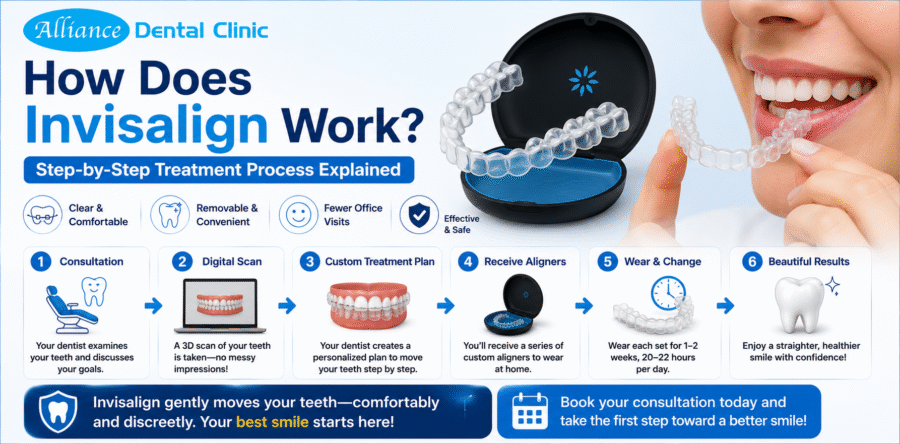
A straighter smile doesn’t always require metal brackets or wires. Thanks to Invisalign, millions of people have chosen a modern orthodontic solution that combines comfort, convenience, and aesthetics. Instead of fixed braces, Invisalign treatment uses removable clear aligners that gradually guide your teeth into healthier positions while fitting seamlessly into your everyday life.
Whether you have crowded teeth, gaps, an overbite, underbite, or mild to moderate bite concerns, Invisalign offers a personalized approach to orthodontic care. Because these invisible braces are nearly transparent, many adults and teenagers appreciate the confidence they provide throughout treatment.
Unlike traditional braces that require regular wire adjustments, Invisalign relies on advanced digital treatment planning. Every aligner is custom-designed to perform specific tooth movements in a carefully planned sequence, helping deliver predictable results. In addition to clear aligners, our orthodontic treatment options can help correct a wide range of bite and spacing concerns.
If you’re wondering how these clear trays actually move teeth, this comprehensive guide explains every stage of the process — from your first consultation to your final smile.
What Is Invisalign?
Invisalign is an advanced orthodontic system that straightens teeth using a series of removable, custom-made clear aligners instead of traditional brackets and wires.
Each aligner is digitally designed using advanced 3D imaging technology to fit your teeth precisely. The aligners are made from a smooth, BPA-free thermoplastic material that fits comfortably over your teeth while applying carefully controlled pressure.
Every aligner is slightly different from the previous one. As you progress through the series, each aligner moves selected teeth by a very small amount until your desired alignment is achieved.
Because Invisalign aligners are removable, patients can continue eating their favourite foods and maintain their regular brushing and flossing routine with fewer challenges than fixed braces.
How Does Invisalign Work?
The effectiveness of Invisalign treatment comes from combining digital treatment planning with gradual biological tooth movement.
Rather than moving every tooth at once, Invisalign creates hundreds of tiny, carefully calculated movements that occur throughout treatment. Here’s exactly how the process works.
Step 1: Initial Invisalign Consultation
Every successful Invisalign journey begins with a comprehensive dental examination. During your consultation, your dentist will evaluate several factors to determine whether you’re a suitable candidate for clear aligners.
Your appointment may include:
- A complete oral examination
- Evaluation of your bite alignment
- Digital photographs
- Digital impressions or 3D intraoral scanning
- Assessment of gum health
- Discussion of your smile goals
- Review of previous orthodontic treatment, if applicable
Modern intraoral scanners create an accurate three-dimensional model of your teeth without the discomfort of traditional dental impressions. This digital model becomes the foundation for your personalized treatment plan.
Step 2: Digital Smile Scan and Personalized Treatment Planning
One of the biggest advantages of Invisalign treatment is its digital planning process. After your scan is completed, specialized software creates a virtual simulation of your teeth. Your dentist carefully plans every stage of movement before your first aligner is even manufactured.
This treatment plan identifies:
- Which teeth require movement
- The direction each tooth will move
- Bite correction goals
- Estimated treatment progression
- Expected final alignment
Many patients appreciate being able to preview a digital simulation of their future smile before treatment begins. This level of precision helps make Invisalign one of today’s most predictable orthodontic solutions.
Step 3: Manufacturing Your Custom Clear Aligners
Once your treatment plan has been approved, your custom clear aligners are fabricated specifically for your smile.
Every aligner is designed to:
- Fit comfortably over your teeth
- Apply gentle, consistent pressure
- Move only selected teeth
- Support precise tooth positioning
- Maintain patient comfort throughout treatment
Unlike traditional braces, there are no metal brackets or wires that can irritate the lips or cheeks. Instead, the smooth edges of Invisalign aligners provide a more comfortable orthodontic experience for many patients.
Step 4: Wearing Your Invisalign Aligners
Consistency is one of the most important factors for successful Invisalign treatment. Most patients are instructed to wear their aligners for approximately 20–22 hours every day.
Aligners should only be removed when:
- Eating meals
- Drinking beverages other than water
- Brushing your teeth
- Flossing
- Cleaning the aligners
Wearing your aligners consistently allows the planned tooth movements to occur on schedule. Removing them too often or wearing them for fewer hours than recommended may delay treatment and affect your final results.
Step 5: How Invisalign Moves Your Teeth
Many patients ask: “How can plastic aligners actually move teeth?” The answer lies in controlled orthodontic biomechanics.
Each Invisalign aligner applies carefully calibrated pressure to specific teeth. This gentle force stimulates the tissues and bone surrounding the tooth roots, allowing them to remodel naturally over time.
As one aligner completes its programmed movement, the next aligner continues the process. Rather than making large adjustments, Invisalign creates many small, highly controlled tooth movements. This gradual progression improves treatment accuracy while helping patients adapt comfortably to each new aligner.
Additionally, some treatment plans may include small tooth-coloured attachments bonded temporarily to certain teeth. These attachments give the aligners additional grip, making complex tooth movements more predictable without affecting the discreet appearance of invisible braces.
Step 6: Switching to Your Next Set of Aligners
Throughout your Invisalign journey, you’ll receive multiple sets of aligners. Most patients change to a new set every one to two weeks, depending on their personalized treatment plan.
Each new aligner continues moving your teeth closer to their ideal positions. It is common to experience slight pressure during the first day or two after changing aligners. This usually indicates that the aligner is actively guiding your teeth according to the treatment plan.
As your teeth adapt, the aligner becomes more comfortable until it’s time for the next stage.
What Dental Problems Can Invisalign Treat?
Modern Invisalign treatment is capable of correcting many orthodontic concerns, not just cosmetic alignment issues. Depending on your individual case, Invisalign may help improve:
- Crowded teeth
- Gaps between teeth
- Crooked teeth
- Mild to moderate overbite
- Mild underbite
- Crossbite
- Open bite
- Relapse after previous orthodontic treatment
- Minor bite alignment problems
Your dentist will determine whether Invisalign is the right solution after reviewing your oral health, bite relationship, and smile goals. According to the Canadian Dental Association (CDA), orthodontic treatment isn’t just for teens — people of any age can benefit from straighter, healthier teeth.
Why Many Patients Choose Invisalign
One reason Invisalign continues to grow in popularity is that it offers a modern orthodontic experience while fitting easily into everyday life. The combination of advanced technology, personalized treatment planning, and removable clear aligners makes it an attractive option for many adults and teens.
Nearly Invisible Appearance
Unlike traditional braces, invisible braces are made from transparent material that blends naturally with your smile. Many patients feel more confident during social events, work meetings, and school because their orthodontic treatment is much less noticeable.
Comfortable to Wear
Every aligner is custom-made for your teeth using smooth thermoplastic material. Without brackets or wires, there is generally less irritation to the lips, cheeks, and gums.
Removable for Everyday Convenience
One of the biggest advantages of Invisalign treatment is that you can remove your aligners before eating and drinking. This means you can continue enjoying your favourite foods without many of the dietary restrictions associated with fixed braces.
Easier Oral Hygiene
Since the aligners are removable, brushing and flossing remain part of your normal routine. Good oral hygiene throughout treatment helps reduce plaque buildup and supports healthier gums.
Digitally Planned Treatment
Modern digital treatment planning allows your dentist to map every stage of tooth movement before treatment begins. This technology helps create a more predictable and personalized orthodontic experience.
How Long Does Invisalign Treatment Take?
Every smile is different, so the length of Invisalign treatment varies from one patient to another. Several factors influence your treatment timeline, including:
- The complexity of tooth movement
- Bite correction requirements
- Your age
- Consistency in wearing aligners
- Following your dentist’s instructions
- Regular progress appointments
Some patients begin noticing visible improvements within the first few months, while more complex orthodontic cases may require additional time. The best way to stay on schedule is to wear your clear aligners for approximately 20–22 hours each day and change to the next aligner only when instructed.
Tips for Successful Invisalign Treatment
Getting the best results from Invisalign depends on following your treatment plan consistently.
Wear Aligners as Directed
Removing aligners too frequently can slow tooth movement. Try to keep them in place except when eating, drinking beverages other than water, brushing, or flossing.
Brush Before Reinserting Aligners
Cleaning your teeth before placing your aligners back in helps prevent food particles and plaque from becoming trapped against your teeth.
Keep Your Aligners Clean
Clean your aligners daily using the method recommended by your dentist. Avoid hot water because excessive heat may distort the plastic.
Store Aligners Properly
Whenever you remove your aligners, place them in their protective storage case to reduce the risk of loss or damage.
Attend Every Progress Appointment
Regular follow-up visits allow your dentist to monitor your tooth movement, ensure your aligners fit correctly, and make any necessary adjustments to your treatment.
Common Mistakes That Can Delay Invisalign Results
Although Invisalign treatment is convenient, certain habits can slow your progress. Avoid these common mistakes:
- Wearing aligners for fewer than 20–22 hours daily
- Forgetting to switch aligners on schedule
- Drinking coffee, tea, soft drinks, or juice while wearing aligners
- Skipping follow-up appointments
- Reinserting aligners without brushing your teeth
- Losing or damaging your aligners
- Ignoring loose attachments or damaged trays
Developing consistent daily habits helps keep your treatment moving according to plan.
Invisalign vs. Traditional Braces
Both Invisalign and traditional braces are effective orthodontic treatments. However, they differ in several important ways.
| Feature | Invisalign | Traditional Braces |
| Appearance | Nearly invisible | Metal or ceramic brackets |
| Removable | Yes | No |
| Eating | Remove aligners before meals | Some food restrictions |
| Oral hygiene | Easier brushing and flossing | More difficult around brackets |
| Comfort | Smooth plastic aligners | Wires and brackets may irritate soft tissues |
| Office visits | Progress monitoring | Regular wire adjustments |
The most appropriate treatment depends on your orthodontic needs, oral health, and professional evaluation. The Canadian Association of Orthodontists (CAO) notes that both fixed and removable appliances can be used to guide teeth into the right position, so a personalized assessment is the best way to choose between them.
Is Invisalign Right for You?
You may be a suitable candidate for Invisalign if you have:
- Crooked teeth
- Crowded teeth
- Gaps between teeth
- Mild to moderate bite concerns
- Teeth that have shifted after previous orthodontic treatment
A complete dental examination, digital scan, and bite assessment help determine whether Invisalign is the best option for your smile. Good oral hygiene habits also support a smoother treatment experience. For general guidance on caring for your teeth and mouth, the Government of Canada’s oral health resources outline healthy daily habits for people of all ages.
Key Takeaways
- Invisalign uses a series of custom-made clear aligners to move teeth gradually
- Every treatment plan is personalized using advanced digital technology
- Wearing aligners for approximately 20–22 hours each day supports successful results
- Good oral hygiene and regular dental visits are essential throughout treatment
- Invisalign can help improve crowded teeth, gaps, and many mild to moderate bite concerns
- A consultation is the best way to determine whether Invisalign is suitable for your specific needs
Explore More Dental Services at Alliance Dental Milton
Whether you’re considering clear aligners or another form of orthodontic care, Alliance Dental Clinic in Milton offers comprehensive dental services for the whole family. In addition to Invisalign, our full range includes:
- Family dentistry — comprehensive care for every member of your household
- Children’s dentistry — gentle, kid-friendly care for toddlers, preschoolers, and school-age children
- Preventive dental care — regular cleanings, fluoride treatments, and oral hygiene guidance
- Professional teeth whitening — brightening your smile once treatment is complete
- Root canal treatment — saving infected teeth before they require extraction
- Dental crowns and bridges — restoring damaged or missing teeth
- Dental implants — permanent tooth replacement
- Tooth extractions — including surgical and impacted wisdom teeth
- Emergency dental care — same-day appointments for urgent issues
Final Thoughts
Invisalign has changed the way people straighten their teeth by combining digital technology with personalized orthodontic care. Instead of relying on brackets and wires, Invisalign treatment uses custom clear aligners to create gradual, controlled tooth movement while offering flexibility in daily life.
Although every treatment plan is unique, the keys to success remain the same: wear your aligners consistently, maintain excellent oral hygiene, and attend regular dental checkups. Following your dentist’s instructions helps ensure that every aligner works as planned and keeps your treatment moving toward the desired result.
If you’re considering invisible braces, scheduling a professional consultation is the first step. A comprehensive examination and digital scan can determine whether Invisalign is the right solution for your smile and oral health goals. Book your consultation today at Alliance Dental Milton.
Frequently Asked Questions
Q: How does Invisalign actually move teeth?
A: Invisalign works by applying gentle, controlled pressure through a series of custom-made aligners. Each aligner moves specific teeth slightly until they reach their planned position.
Q: How many hours a day should I wear Invisalign?
A: Most patients should wear their clear aligners for 20–22 hours every day for the treatment to progress as planned.
Q: Can Invisalign fix overbite, underbite, and crowded teeth?
A: Yes. Invisalign treatment can often correct crowded teeth, spacing issues, overbites, underbites, crossbites, and several other orthodontic concerns, depending on the complexity of the case.
Q: Is Invisalign painful?
A: Patients commonly experience mild pressure when switching to a new aligner. This temporary sensation usually indicates that the aligners are working as intended and often improves within a few days.
Q: Can I eat while wearing Invisalign?
A: No. Remove your aligners before eating or drinking anything other than plain water. This helps prevent staining, damage, and food buildup inside the trays.

