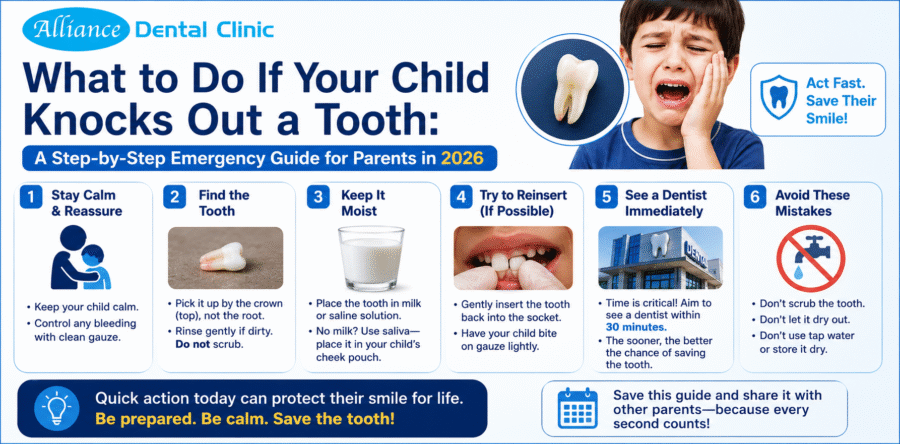
A child can knock out a tooth in seconds—during soccer, on the playground, while riding a bike, or even after slipping at home. In that moment, most parents panic and search for the same thing: what should I do if my child knocks out a tooth?
The right response depends on whether the tooth is a baby tooth or a permanent tooth. That detail matters because the first-aid steps are not the same. A children dentist can help assess the injury, protect nearby teeth, and guide the next steps quickly. In some cases, acting fast may even help save a permanent tooth.
This guide explains exactly what parents should do after a child knocks out a tooth, when to call a kids dentist, how to handle the tooth safely, and when the injury needs urgent Pediatric dental care.
Quick Answer: What Should You Do If Your Child Knocks Out a Tooth?
If your child knocks out a tooth:
- Stay calm and check for bleeding or head injury first.
- Find the tooth and hold it by the crown, not the root.
- Figure out if it is a baby tooth or a permanent tooth.
- Do not put a baby tooth back in.
- If it is a permanent tooth, try to place it back gently or keep it moist in milk.
- Call a children dentist or child dental clinic immediately.
Those first 15 to 60 minutes can matter, especially if a permanent tooth has been knocked out.
Why a Knocked-Out Tooth Is a Dental Emergency
A completely knocked-out tooth is called an avulsed tooth. In pediatric dentistry, tooth avulsion is considered a time-sensitive dental emergency because the tissues around the root begin to dry out quickly once the tooth is out of the mouth.
That is why parents should not “wait and see” when a child loses a tooth after trauma. According to the Canadian Dental Association (CDA), acting quickly and handling the tooth correctly can make the difference between saving and losing it. Even if the bleeding slows down, the injury may still affect:
- the gum and surrounding soft tissue
- nearby teeth and roots
- the developing permanent tooth under a baby tooth
- the child’s bite and jaw comfort
- the chance of saving a permanent tooth
A children dentist will want to know how the injury happened, how long the tooth has been out, whether it is a baby or permanent tooth, and how the tooth was stored.
Step 1: Check Your Child for Serious Injury First
Before focusing only on the tooth, look at your child’s overall condition. Some dental injuries happen with lip trauma, jaw injuries, or even a concussion.
Seek urgent medical help right away if your child has:
- heavy bleeding that will not stop
- vomiting, dizziness, or confusion
- loss of consciousness
- trouble breathing or swallowing
- severe facial swelling
- jaw pain or trouble opening the mouth
- a deep cut to the lips, gums, or tongue
- a suspected head or neck injury
If your child is alert and stable, move on to the tooth and call your children dentist as soon as possible.
Step 2: Find the Tooth and Pick It Up the Right Way
If the tooth is on the floor, grass, or pavement, find it quickly and pick it up only by the crown. The crown is the part of the tooth you normally see in the mouth. Do not touch the root.
This is one of the most important steps in a dental trauma emergency. The root surface contains delicate cells that help a permanent tooth reattach. Scrubbing, wiping, or touching the root can damage those cells.
Do this:
- hold the tooth by the top white part only
- keep it clean and moist
- handle it gently
Do not do this:
- do not scrub the tooth
- do not wrap it in tissue
- do not let it dry out
- do not touch the root if you can avoid it
Parents often search “my child knocked out a front tooth—can I wash it?” The answer is yes, but only gently and only if it is dirty.
Step 3: Decide if It Is a Baby Tooth or a Permanent Tooth
This is the most important question after a dental injury.
If it is a baby tooth
Do not try to put it back into the gum. Replanting a baby tooth can damage the permanent tooth developing underneath. Your child should still see a children dentist or child dental clinic quickly to check the gums, nearby teeth, and the underlying area.
If it is a permanent tooth
This is a true dental emergency. A permanent tooth may sometimes be saved if it is handled properly and seen quickly by a kids dentist.
Not sure whether it is a baby or permanent tooth?
Call a children dentist immediately and describe your child’s age and which tooth was knocked out. According to the Government of Canada, the upper and lower front permanent teeth typically begin to come in around age 6 to 8, though the timing can vary from child to child.
Step 4: If It’s a Permanent Tooth, Try to Reinsert It If Possible
If the knocked-out tooth is a permanent tooth and your child is calm enough, you may be able to gently place it back into the socket while you head to the dentist.
Here is how:
- If the tooth is dirty, rinse it gently for a few seconds with milk or saline.
- Hold it by the crown only.
- Make sure it is facing the correct direction.
- Gently place it back into the socket.
- Ask your child to bite softly on clean gauze or a cloth to help hold it in place.
If it does not slide in easily, do not force it. If your child is very upset or you are unsure, skip this step and move to proper storage instead. The goal is to protect the root surface and get to a children dentist fast.
Step 5: If You Can’t Put It Back, Keep the Tooth Moist
A knocked-out permanent tooth should never be allowed to dry out. Keeping it moist helps protect the cells on the root and may improve the chances of successful reimplantation. HealthLink BC notes that results are best when a dentist can reimplant the tooth within about 30 minutes, and that the chances of success drop sharply after 2 hours.
Best storage options for a permanent tooth:
- cold milk
- saline solution
- a tooth preservation solution if you have one
- the child’s saliva in a clean container
Avoid these common mistakes:
- do not leave the tooth dry in a napkin or tissue
- do not scrub the root with a toothbrush
- do not soak it in hot water
- do not use soap, disinfectant, or toothpaste
- do not keep it in plain water for long if better options are available
If your child knocked out a baby tooth, you do not need to store it for reimplantation, but it can still be helpful to bring it to the dental visit so the children dentist can confirm what happened.
Step 6: Control Bleeding and Swelling
While preparing to go to the dental office, focus on keeping your child comfortable.
To manage bleeding and swelling:
- place clean gauze over the area and ask your child to bite gently
- apply a cold compress to the outside of the cheek for 10–15 minutes at a time
- keep your child upright if possible
- avoid crunchy, spicy, or very hot foods
- reassure your child and keep them calm
If the area is painful, your dental team may guide you on what to do next based on your child’s age and medical history.
Step 7: Call a Children Dentist or Child Dental Clinic Immediately
Do not wait until the next day if a permanent tooth has been knocked out. Contact a children dentist right away and explain:
- your child’s age
- whether the tooth appears to be baby or permanent
- how the injury happened
- how long the tooth has been out of the mouth
- whether you placed it back or stored it in milk
- whether there is bleeding, swelling, or facial trauma
If your child has a baby tooth injury, the visit is still important. Trauma to a baby tooth can affect nearby teeth, the gums, or the permanent tooth that is still developing under the surface.
What Happens at the Dental Office?
At the appointment, the children dentist will examine the injured area and may take dental X-rays to check the socket, the surrounding bone, and nearby teeth.
Treatment depends on the type of tooth and the severity of the injury. Your child may need:
- an exam of the tooth socket and gums
- X-rays to check for hidden injury
- repositioning or stabilization of a permanent tooth
- monitoring of nearby teeth for fractures or nerve damage
- follow-up visits to track healing
- guidance on eating, cleaning, and protecting the area at home
A child dental clinic may also look for signs that the trauma affected the lips, tongue, bite, or jaw alignment. If a tooth cannot ultimately be saved, options such as space maintainers or, later in life, dental implants can help restore the smile.
Baby Tooth vs Permanent Tooth: What Parents Need to Remember
Parents often search “what happens if my child knocks out a baby tooth?” or “can a dentist save a knocked-out permanent tooth?” The answer depends on the type of tooth.
If your child knocks out a baby tooth:
- do not reinsert it
- control bleeding with gauze
- use a cold compress
- contact a children dentist
- book an urgent dental evaluation
If your child knocks out a permanent tooth:
- pick it up by the crown
- rinse gently if dirty
- try to place it back in the socket if possible
- if not, keep it in milk or saline
- get emergency Pediatric dental care immediately
That single difference—baby tooth versus permanent tooth—changes the safest next step. If nerve damage is suspected in a nearby tooth, your dentist may also monitor whether a root canal treatment is needed down the road.
Common Mistakes Parents Make After a Knocked-Out Tooth
Many parents search Reddit, parenting forums, Quora, and Google after a tooth injury. The same mistakes show up again and again.
1. Putting a baby tooth back in
This can damage the permanent tooth developing underneath.
2. Touching the root too much
The root surface is delicate and should be handled as little as possible.
3. Letting the tooth dry out
A permanent tooth should stay moist while your child is on the way to the kids dentist.
4. Waiting too long to call a dentist
A knocked-out permanent tooth should be seen as soon as possible.
5. Assuming the injury is minor because the bleeding stopped
The gums, bone, or nearby teeth may still be injured even if the area looks better.
When a Child Should See a Dentist Even if It Was “Just a Baby Tooth”
A baby tooth may not be replanted, but the injury still needs attention. Trauma to a primary tooth can affect the gums, speech, comfort, and the developing adult tooth underneath. A trusted family dentist who already knows your child’s dental history can make this follow-up visit far less stressful.
Contact a children dentist if your child has:
- ongoing bleeding
- swelling that gets worse
- a loose nearby tooth
- pain when biting
- a chipped tooth after the fall
- a cut lip or gum
- a tooth that changes color after the injury
- trouble eating or speaking normally
A children dentist can check whether the surrounding teeth were damaged and whether the area is healing as expected.
How to Help Prevent Knocked-Out Teeth in Children
Not every accident can be prevented, but some habits lower the risk of dental trauma.
Prevention tips from a children dentist:
- use a mouthguard for sports and high-impact activities
- make sure helmets fit properly for biking and skating
- childproof slippery floors and sharp furniture edges
- avoid running with toys or objects in the mouth
- schedule routine preventive dental care visits
- ask an orthodontist if your child’s front teeth stick out or are more vulnerable to injury
Regular visits to a child dental clinic can also help spot bite issues and habits that may increase the risk of dental trauma.
Final Thoughts
If your child knocks out a tooth, the most important thing is to stay calm, identify whether the tooth is baby or permanent, and contact a children dentist quickly. A knocked-out baby tooth should not be put back in, but a permanent tooth may sometimes be saved if it is handled correctly and kept moist until your child receives emergency care.
Here is the key takeaway for parents:
- check for serious injury first
- pick up the tooth by the crown only
- never reinsert a baby tooth
- keep a permanent tooth moist in milk or saline
- see a children dentist or child dental clinic as soon as possible
Fast action can protect your child’s comfort, reduce complications, and improve the chances of a better long-term outcome after dental trauma. Alliance Dental Clinic offers a full range of dental services for children and families in Milton, including same-day care for dental emergencies.
FAQs About a Child Knocking Out a Tooth
Q: What should I do first if my child knocks out a tooth?
A: First, check for bleeding, head injury, or facial trauma. Then find the tooth, hold it by the crown only, and call a children dentist immediately. If the tooth is permanent, keep it moist and seek emergency dental care right away.
Q: Should I put a knocked-out baby tooth back in?
A: No. A knocked-out baby tooth should not be replanted because it can damage the permanent tooth developing underneath the gums. Your child should still be seen by a children dentist for an exam.
Q: Can a knocked-out permanent tooth be saved in a child?
A: Sometimes, yes. A knocked-out permanent tooth may be saved if it is handled properly, kept moist, and treated quickly by a kids dentist or emergency dental provider.
Q: What is the best thing to store a knocked-out tooth in?
A: For a permanent tooth, the best storage options are cold milk, saline, or a tooth preservation solution. If those are not available, the child’s saliva in a clean container can help keep the tooth moist until you reach a child dental clinic.
Q: How do I know if my child knocked out a baby tooth or a permanent tooth?
A: A children dentist can confirm it, but many front permanent teeth begin coming in around ages 6 to 8. If you are not sure which tooth it is, treat it like an emergency and call your dental office right away.

