If your toothache has gone from “annoying” to “I can feel my heartbeat in my jaw,” the problem may be deeper than a cavity. In many cases, that kind of pain happens when infection or inflammation reaches the soft tissue inside the tooth, called the dental pulp. When the damage becomes advanced, your dentist may recommend Root Canal Treatment to save the tooth and stop the infection from spreading. If you’re in Milton and searching for a trusted root canal specialist, understanding what stage your tooth is at is the first step toward the right treatment.
You may also come across the phrase “Stage 3 Root Canal Treatment.” It is not a universal formal diagnosis used by every dental association, but patients and clinics often use it to describe a more advanced stage of pulp infection or irreversible pulp damage—the point where the tooth usually cannot heal on its own and needs endodontic care. In simple terms, the infection has moved beyond mild irritation and into a stage where cleaning the inside of the tooth is often the best way to preserve it.
This guide explains what Stage 3 root canal treatment usually means, which symptoms matter most, how root canal therapy works, how long recovery takes, and when it’s time to see a root canal specialist rather than waiting it out. At Alliance Dental Clinic, our team walks every patient through this decision with a proper exam rather than guesswork.
Quick Answer: What Is Stage 3 Root Canal Treatment?
Stage 3 root canal treatment generally refers to a tooth with advanced pulp inflammation, pulp infection, or pulp necrosis that requires Root Canal Treatment to remove infected tissue, disinfect the canals, and seal the tooth. It often involves symptoms such as severe tooth pain, lingering hot or cold sensitivity, pain while biting, swelling, or a dental abscess. The goal is to save the natural tooth, relieve pain, and prevent the infection from affecting the surrounding bone and gum tissue. The Canadian Dental Association (CDA) notes that modern imaging and techniques now allow dentists and endodontists to treat even very complex root canal anatomy with a high level of precision.
What Happens Inside the Tooth During a Root Canal Problem?
Every tooth has a hard outer shell made of enamel and dentin. Inside that shell is the pulp chamber, which contains nerves, blood vessels, and connective tissue. When bacteria enter the pulp through deep tooth decay, a cracked tooth, trauma, or a leaking filling, the pulp can become inflamed. At first, that inflammation may be reversible. But if the irritation continues, the pulp can reach a stage called irreversible pulpitis, where it can no longer heal on its own.
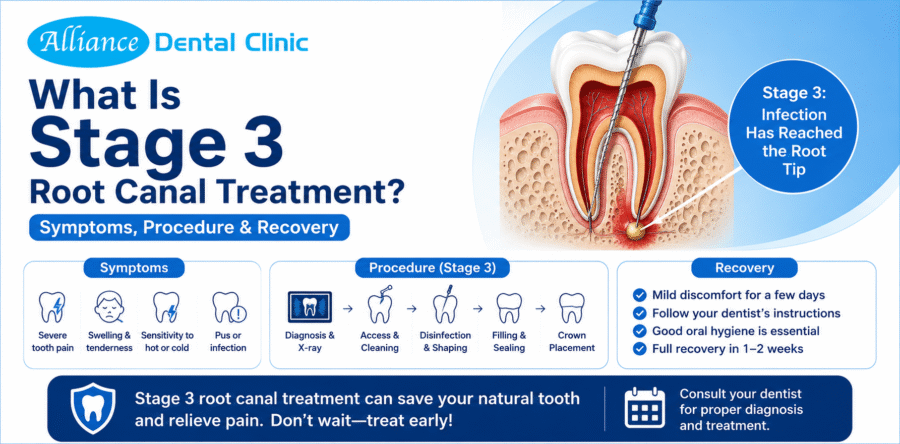
At that point, the pressure inside the tooth rises, pain often becomes more intense, and bacteria may travel through the root tip into the surrounding bone. This can lead to apical periodontitis, swelling, or an abscess. That is the stage many people online refer to as “Stage 3.”
Expert Insight: In our years providing family dentistry in Milton, the most common question we hear is, “How did this happen so fast?” In reality, it rarely happens fast — the pulp has usually been quietly inflamed for weeks before pain becomes constant. Catching it earlier almost always means a simpler, more comfortable treatment. — Alliance Dental Team
What Does “Stage 3” Usually Mean in Root Canal Treatment?
Because there is no single official universal “stage 1, 2, 3” system for root canals used across all practices, it helps to think of Stage 3 Root Canal Treatment as a patient-friendly way of describing an advanced infection stage. In practical dental terms, it often means one or more of the following:
- The pulp is irreversibly inflamed and cannot recover
- Part of the pulp has become infected or necrotic
- The tooth has symptoms of deep nerve pain or pressure
- Infection may be visible near the root tip on an X-ray
- The tooth needs Root Canal Treatment rather than a simple filling
So while “Stage 3” is not a formal coding term, the message behind it is important: the tooth likely needs active treatment, not just monitoring.
Common Causes of Stage 3 Root Canal Treatment Problems
A tooth usually does not reach this stage in one day. In most cases, the problem develops gradually because bacteria keep gaining access to the inside of the tooth. Common causes include:
1) Deep tooth decay
A large cavity can move through enamel and dentin until it reaches the pulp, causing infection and pain.
2) A cracked or fractured tooth
Even a small crack can give bacteria a pathway into the tooth’s nerve tissue.
3) Trauma to the tooth
A fall, sports injury, or bite trauma can damage the pulp even if the tooth looks fine from the outside.
4) Repeated dental work on the same tooth
Multiple fillings or restorations can stress the tooth over time and irritate the pulp.
5) A leaking crown or filling
If a restoration no longer seals properly, bacteria can re-enter and cause a new infection.
6) Untreated dental infection
A tooth that has been painful for weeks or months can progress from inflammation to pulp death and infection around the root.
Symptoms of Stage 3 Root Canal Treatment
One of the most common search questions is: “How do I know if I need Root Canal Treatment?” The answer depends on a clinical exam, but there are warning signs that should not be ignored.
1. Severe tooth pain that keeps coming back
Pain may be constant, throbbing, or worse at night. It can also spread to the jaw, ear, or nearby teeth.
2. Lingering sensitivity to hot or cold
A brief twinge is not always a big problem. But if hot coffee or cold water triggers pain that lingers for seconds or minutes, the pulp may be inflamed or infected.
3. Pain when chewing or biting
If one tooth suddenly feels “too tall,” bruised, or sharply painful when biting, the inflammation may have reached the tissues around the root.
4. Swollen or tender gums near the tooth
Swelling, redness, or a pimple-like bump on the gum can be a sign of an abscess draining from the infected tooth. The HealthLink BC resource on abscessed teeth notes that this kind of swelling, along with a bad taste in the mouth, is one of the clearest signals that a tooth infection needs prompt attention.
5. Tooth discoloration
A tooth that turns darker, grey, or yellow-brown compared with neighboring teeth may have internal pulp damage.
6. A bad taste in the mouth or persistent bad breath
An abscess that drains can leave an unpleasant taste or smell.
7. Facial swelling or pressure
If infection spreads beyond the tooth, swelling may affect the gum, jaw, or part of the face. This level of swelling is one of the signs that warrants same-day emergency dental care rather than waiting for a routine appointment.
Not every tooth infection is dramatic. Some patients have low-grade symptoms for weeks before the tooth flares up. Others have very little pain but a visible infection on X-ray. That’s why symptoms alone are not enough to diagnose the problem.
[From Practice] A patient came in describing “just a little sensitivity” on one back tooth, assuming it wasn’t serious enough for an appointment. On examination and X-ray, the pulp was already necrotic with early infection near the root tip — a textbook Stage 3 presentation despite the mild symptoms. Treatment that week prevented a much more painful flare-up later. This is exactly why we tell patients: let the exam decide, not the pain level alone. — Alliance Dental Team
How Dentists Diagnose the Need for Root Canal Treatment
A proper diagnosis matters because not every painful tooth needs Root Canal Treatment, and not every tooth that needs a root canal causes dramatic pain. Dentists and root canal specialists use a combination of clinical findings and imaging to work out what is happening.
A diagnostic visit may include:
- A review of your symptoms and pain history
- Checking for deep decay, cracked tooth structure, or a failing filling
- Testing the tooth with hot, cold, or tapping pressure
- Looking for swelling, sinus tracts, or gum tenderness
- Taking digital dental X-rays to check the root and surrounding bone
- In some cases, pulp testing or 3D imaging for complex cases
This is one of the strongest E-E-A-T points in dental content: you cannot confirm a root canal diagnosis from symptoms alone. A clinical exam is essential because pain can also come from cracked tooth syndrome, bite trauma, gum infection, or sinus-related pressure. Our dental services team always starts with a full diagnostic exam before recommending treatment.
Root Canal Treatment Procedure: Step by Step
A lot of online fear about root canal therapy comes from old stories, not modern dentistry. Today, the procedure is designed to remove infection, reduce pain, and preserve your natural tooth whenever possible.
Here’s what typically happens during Root Canal Treatment:
Step 1: The tooth is numbed
Your dentist or endodontist uses local anesthetic to numb the tooth and surrounding area. If the nerve is severely inflamed, getting the tooth fully comfortable can take a little more planning, but comfort control is a normal part of the procedure.
Step 2: The tooth is isolated
A small protective sheet called a dental dam is placed around the tooth. This keeps the area dry and reduces contamination from saliva.
Step 3: A small access opening is made
The dentist creates a small opening in the top of the tooth to reach the pulp chamber and root canals.
Step 4: The infected pulp is removed
Tiny instruments are used to remove the inflamed or infected pulp tissue from the inside of the tooth.
Step 5: The canals are cleaned and shaped
This is the heart of root canal therapy. The canals are disinfected, shaped, and flushed to remove bacteria and infected debris.
Step 6: The canals are filled
Once the canals are clean and dry, they are filled with a biocompatible material—commonly gutta-percha—to seal the space.
Step 7: The tooth is sealed and restored
The opening is closed with a filling, and many teeth later receive a dental crown for long-term protection, especially back teeth that handle heavy chewing.
Some root canals are completed in one appointment. Others take two visits if the infection is more complex, the anatomy is difficult, or a temporary medicated dressing is needed between visits.
Expert Insight: Patients are often surprised that the appointment itself is the calm part — it’s the days leading up to it, with untreated pain, that are hardest. Once the infected pulp is out and the pressure is relieved, most people feel noticeably better within a day. — Alliance Dental Team
Does Root Canal Treatment Hurt?
This is one of the most searched questions on Google, Reddit, and dental forums. The short answer is: the infection usually hurts more than the treatment.
With modern local anesthesia, most patients describe Root Canal Treatment as similar to getting a large filling, just longer. You may feel pressure, vibration, or your mouth getting tired from staying open, but sharp pain during the procedure is not the goal.
After treatment, mild soreness is normal. The tooth and surrounding ligament may feel tender for a few days, especially if the infection was already advanced before treatment. Dental aftercare guidance from endodontic and hospital sources also notes that post-treatment soreness can happen even when the procedure goes well, particularly in teeth that were very inflamed beforehand.
Root Canal Recovery: What to Expect
One reason “root canal recovery” is such a common search topic is that people want to know whether post-treatment discomfort means something went wrong. In most cases, it does not.
What feels normal after Root Canal Treatment?
For the first few days, you may notice:
- Mild tenderness when chewing
- A bruised feeling around the tooth
- Temporary gum soreness
- Jaw stiffness after a long appointment
- Mild swelling or pressure around the treated area
Most people feel noticeably better within a few days to one week, although some teeth remain tender a little longer if there was a large infection or the surrounding tissues were already inflamed. NHS and endodontic guidance both note that soreness after treatment can be expected and usually improves gradually.
Recovery tips after root canal therapy
- Avoid chewing hard foods on the treated tooth until your dentist says it’s safe
- Brush and floss gently but consistently
- Keep all follow-up appointments
- If a crown is planned, don’t delay the final restoration
- Choose softer foods for a day or two if the tooth feels tender
- Follow the aftercare instructions from your dentist or endodontist
When should you call the dentist after a root canal?
Contact the dental office if you have:
- Severe pain or pressure that lasts more than a few days
- Visible swelling inside or outside the mouth
- Fever, difficulty swallowing, or worsening facial swelling
- A temporary filling or temporary crown that comes out
- Symptoms that disappear and then return strongly later
[From Practice] A patient once called two days after treatment, worried that mild tenderness while chewing meant the root canal had failed. On review, this was completely normal healing — the ligament around the tooth was still settling down after the infection. We always tell patients: mild and improving is normal; severe and worsening is the signal to call. — Alliance Dental Team
Why a Crown Is Often Recommended After Root Canal Treatment
A root canal treats the inside of the tooth, but it does not automatically strengthen the outside. After Root Canal Treatment, the tooth may be more brittle if it already had a large cavity, a crack, or extensive loss of structure.
A crown is often recommended when:
- The tooth is a molar or premolar under heavy chewing pressure
- A large amount of tooth structure has been removed
- The tooth already had a large filling
- There is a crack risk
- The goal is to protect the tooth from future fracture
This is also one of the most common Reddit and forum questions: “If the root canal is done, do I still need the crown?” In many cases, yes—the crown is what helps protect the tooth long-term. Our dental crown treatment is often planned at the same visit as the root canal so patients aren’t left with an unprotected tooth in between.
Can Stage 3 Root Canal Treatment Be Avoided?
Sometimes yes, but only if the problem is caught early. A tooth with mild reversible inflammation may improve with a filling, crack protection, or removal of the source of irritation. But once the pulp reaches irreversible pulpitis, pulp necrosis, or apical infection, the tooth generally needs Root Canal Treatment or extraction.
The best way to avoid a root canal is still the least glamorous advice in dentistry:
- Don’t ignore lingering tooth pain
- Get cavities treated before they deepen
- Replace failing fillings or crowns when recommended
- Wear a nightguard if you clench or grind
- Book an exam for cracked teeth, trauma, or sudden sensitivity
Expert Insight: Consistent preventive dental care is genuinely the best defense here. Most of the Stage 3 cases we see started as a small cavity or a hairline crack that went unchecked for a year or more. A six-month checkup catches these problems while they’re still simple to treat. — Alliance Dental Team
When to See a Root Canal Specialist
Many general dentists perform root canals very well, but some cases are better handled by a root canal specialist, also called an endodontist. You may be referred if:
- The tooth has curved, narrow, or hard-to-find canals
- A previous root canal has failed and needs retreatment
- There is a suspected root fracture
- The infection is large or complex
- The diagnosis is unclear and advanced imaging may help
Endodontists focus specifically on diseases of the dental pulp and root canal system, which makes them especially valuable for complicated molars, retreatment cases, and persistent symptoms. The Canadian Academy of Endodontics describes an endodontist as a dentist with two or more years of advanced training beyond general dentistry, focused entirely on saving teeth through root canal care.
Final Thoughts
Stage 3 root canal treatment usually describes a tooth that has moved beyond mild irritation and into advanced pulp infection or irreversible damage. In that situation, Root Canal Treatment is often the best option to remove infection, relieve pain, and save the natural tooth.
The most important takeaway is this: don’t diagnose a root canal from Google alone. A severe toothache, lingering sensitivity, gum swelling, or pain when biting can all point toward an infected pulp—but they can also overlap with other dental problems. A proper dental exam, pulp testing, and X-rays are what confirm whether you need root canal therapy and whether the tooth should be treated by a general dentist or a root canal specialist.
If your tooth is throbbing, swelling, or keeping you up at night, that’s not the time for heroic patience. It’s the time for a dental exam. Book a consultation with Alliance Dental Clinic and we’ll help you find out exactly where your tooth stands.
Frequently Asked Questions About Root Canal Treatment
1) What are the signs that I might need Root Canal Treatment?
The most common signs include severe tooth pain, lingering hot or cold sensitivity, pain when chewing, gum swelling, tooth discoloration, or a pimple-like bump on the gums. These symptoms do not confirm a root canal by themselves, but they are strong reasons to see a dentist promptly.
2) Is Stage 3 Root Canal Treatment the same as an abscessed tooth?
Not always, but they can overlap. “Stage 3” is often used informally to describe advanced pulp damage or infection. Some of those teeth also develop an abscess or infection around the root tip, while others are severely inflamed without a large visible abscess.
3) How long does Root Canal Treatment recovery take?
Most patients start feeling better within a few days to one week. Mild tenderness when chewing can happen for a short time, especially if the tooth had a significant infection before treatment. If pain is getting worse instead of better, you should contact your dentist.
4) Why does a tooth still feel sore after root canal therapy?
The inside of the tooth is cleaned during treatment, but the ligament and bone around the tooth may still be inflamed from the original infection or bite pressure. Mild soreness can be normal during healing. Persistent swelling, severe pain, or returning symptoms need re-evaluation.
5) Do I always need a crown after Root Canal Treatment?
Not always, but many back teeth do. Molars and premolars often need a crown because they take heavy chewing force and may be weaker after infection, decay, or large fillings. Your dentist will decide based on how much healthy tooth structure remains. Our team at Alliance Dental Clinic will walk you through this decision at your follow-up visit.

